


The last time a Democrat was elected as mayor of Miami, Bill Clinton was president.
Over the ensuing decades, Miami became such a consistently Republican town that outgoing Mayor Francis Suarez—who was reelected in 2021 with almost 80 percent of the vote—briefly sought the party’s 2024 presidential nomination.
But on Tuesday, Miami voters replaced Suarez with Democrat Eileen Higgins,a Peace Corps alumnus, former foreign service officer in Latin America, and Miami-Dade County commissioner with a track record of championing affordable housing, mass transit expansion, and environmental initiatives.
Running with ardent support from President Trump—who declared before the vote, “Miami’s Mayor Race is Tuesday. It is a big and important race!!! Vote for Republican Gonzalez”—as well as Florida Governor Ron DeSantis and Florida Senator Rick Scott, González had all the pieces in place for a win. But he couldn’t overcome the fundamental reality of 2025.
Americans are now so soured on Trump (whose economic mismanagement, chaotic governance, and authoritarian overreach have dropped his approval rating as low as 36 percent in a late-November Gallup survey) and the GOP brand that they are turning out anywhere and everywhere to vote for Democrats.
That was the case in Miami, a city with a large Latino population that not long ago was seen as an emerging base for the Republicans. Now CNN data analyst Harry Enten notes,“Latinos have shifted heavily against Trump (with a drop of 36 points in net approval).”
In a broader sense, says Enten, “Trump’s absolute kryptonite to the GOP in big cities.”
But this is about much more than big cities.
Democrats are breaking through all over, showing strength even in Republican regions where maps are gerrymandered to favor the GOP.
Last week’s returns from a Tennessee special election for an open US House seat show that Democrat Aftyn Behn’s strong run produced a 13-point shift away from the GOP in a normally safe Republican district. A 13-point shift nationally in 2026—or anything akin to that level of movement—would flip dozens of Republican House seats and give Democrats clear control of the chamber for the last two years of Trump’s presidency.
That prospect is not lost on the president.
Amid mounting discomfort on the part of congressional Republicans—many of whom are reportedly pondering standing down rather than risk getting wiped out in a blue wave next year—Trump has launched a desperate tour of battleground states. But if his often contradictory rambling about inflation and other economic challenges during a Pennsylvania stop on Tuesday night is anything to go by, his campaigning is unlikely to renew GOP fortunes.
Democrats have zeroed in on the cost-of-living challenges facing Americans across the country to considerable electoral success. Rather than counter with his own affordability agenda, Trump is resorting to his usual tactics, saying that the focus on the issue is a “hoax,” a “con job,” and a “scam.” He hit this theme repeatedly in Pennsylvania; as CBS News reported,“Mr. Trump criticized Democrats for focusing on affordability issues in Tuesday’s speech, though he said: ‘I can’t call it a hoax because they’ll misconstrue that.’” Then the network added, “Last week, the president called the affordability issue a ‘fake narrative”’ made up by Democrats to sway the public. But at the same time, he said he had inherited problems with affordability from his predecessor [former President Joe Biden].”
The prospect that Trump’s approval ratings could get even worse, and that disgust with a Republican-led Congress will do further damage to the GOP brand, has huge significance for the 2026 midterm elections, which will be the last significant chance voters have to place meaningful checks on Trump’s presidency. That’s what happened after the 2018 midterm elections during the president’s first term, when Democrats flipped control of the House and made major gains in the states.
At the close of an off-year election season that has seen Democrats steadily boost turnout and overperform in critical state and local contests, as well as special elections for legislative and congressional seats, the Miami result serves, in the words of Democratic National Committee chair Ken Martin, as a “testament to what Democrats can accomplish when we organize and compete everywhere.”
Reflecting on Tuesday’s returns, in which a Democrat flip a heavily gerrymandered state legislative seat in Georgia—reversing a 22-point Republican advantage—and a scattering of end-of-the-year legislative contests from Iowa to Florida produced double-digit or higher swings to the Democratic candidates, Martin said, “Tonight’s result is yet another warning sign to Republicans that voters are fed up with their out-of-touch agenda that is raising costs for working families across the country.”
While partisans always put the best spin on election results—and while their rivals seek to discount them—the message from 2025 could not be clearer. The record of Trump and his administration, as well as that of the president’s allies in Congress, has become a massive burden for the Republican Party and is setting up a 2026 election cycle that could produce an epic smackdown for the GOP.
In 2025 alone, Democrats have won the governorships of Virginia (a flip from the GOP) and New Jersey, as well as overwhelming legislative majorities in those states. Along with their progressive allies, they have won critical state supreme court contests in Pennsylvania and Wisconsin (officially a nonpartisan race, but with a clear partisan overlay). They have won mayoralties that had long been in Republican hands in red states across the country. They have scored groundbreaking wins in down-ballot state races—like November’s statewide contests in Georgia, where the Associated Press noted,
Two Democrats romped to wins over Republican incumbents in elections to the Georgia Public Service Commission on Tuesday, delivering the largest statewide margins of victory by Democrats in more than 20 years. Wins by Democrats Peter Hubbard and Alicia Johnson over Republicans Fitz Johnson and Tim Echols are the first time Democrats have won statewide elections to a state-level office in Georgia since 2006. The victories could juice Democratic fundraising and enthusiasm next year, when Georgia’s ballot will be topped by Democratic U.S. Sen. Jon Ossoff’s reelection bid and an open governor’s race.
The Capitol Hill insider newspaper The Hill observed after it became clear that Higgins would secure a landslide in Miami, “The win is the latest boost for Democrats, who are coming out of better-than-expected elections in November and a strong showing in this month’s special House election in Tennessee. The party hopes an energized base and a focus on issues such as affordability will help flip the House and possibly even the Senate in next year’s midterms.”
The same is true in the fight for control of the states.
Results from legislative special elections and regular off-year contests in 2025 suggest that the Democrats are also securing significant gains in suburban and rural areas. “Democrats, buoyed by Trump’s unpopularity and a fired-up base, flipped 21 percent of all the GOP-held seats that were on the ballot throughout 2025,” reported The Bolts newsletter. Those results meant Democratic legislative caucuses expanded in Virginia, New Jersey, Georgia, Iowa, Mississippi and Pennsylvania. Were that pattern to repeat in 2026, it would remake the politics of states across the country—putting more legislative chambers in Democratic hands; giving Democratic governors the ability to advance bold agendas; and, by ending Republican supermajorities in red states, allowing Democrats to check and balance right-wing governors.
Even in 2025 legislative contests where Democrats were not winning outright majorities, they were advancing with such strength that 2026 candidates were excited by the numbers. Consider the case of an Iowa legislative special-election race on Tuesday in a historically Republican district. The GOP nominee finished ahead, but did so with a dramatically reduced advantage.
Popular
“swipe left below to view more authors”Swipe →
“Tonight, we’re seeing a 17-point over performance for Iowa Democrats,” explained Democratic US Senate candidate Zach Wahls, who hopes to be his party’s nominee next year in the race to replace Republican Senator Joni Ernst. “Our 2022 U.S. Senate race was decided by 12 points. Together, we can flip this seat next year and bring real change to the U.S. Senate.”
If the red state of Iowa could be in play in the competition for control of the Senate next year—along with more predictably winnable states such as Maine, Ohio and North Carolina—the prospect of a Democratic takeover becomes a real one. And if Democrats can win the Senate, along with the more easily flipped House, then Trump becomes as lame a duck as could be.
And the GOP could hit the skids in Washington—and in state capitals nationwide.
Indeed, the most consistent pattern of recent Democratic advances has been in legislative contests where, according to the Democratic Legislative Campaign Committee,“The DLCC’s data shows that state legislative Democrats overperformed 2025 elections in targeted districts by 4.5 points on average, which if replicated in 2026 elections would provide the most significant Democratic gains at this ballot level in two decades.”
With an eye toward putting 650 state legislative seats in play nationwide—as part of a plan to create majorities in states where the Democrats have not had advantages for years—the DLCC announced Wednesday that it will expand its target map to include at least 42 state legislative chambers. That’s the most targets ever for the committee. And the group’s plan to spend $50 million in 2026 races represents its largest single-year investment.
“2026 is a once-in-a-generation opportunity to fundamentally transform state legislative power,” says DLCC president Heather Williams. “With multiple new majorities and trifectas in play next year, this isn’t a moment for modest gains—we are thinking more expansively than ever to sweep the landscape and create lasting power in statehouses. Beyond cementing Democratic state power, our 2026 wins will fundamentally shift power up and down the ticket and shape the future of Democratic power for years to come. The favorable political environment taking shape for Democrats is on a scale that only comes once in a generation, and the DLCC is poised to meet this moment through the largest target map and political budget ever. We aren’t wasting a moment to execute on our winning strategy.”
The possibility that Democrats could secure 2026 victories of a sort that come once in a generation—flipping the US House, the US Senate, governorships, and legislative chambers across the country—will no doubt produce mounting angst for Trump. He’ll keep lashing out, claiming that the Democratic focus on affordability is a “scam,” and that inflation concerns are a “hoax.” But the president’s angst is nothing compared to the frustration felt by the voters who have recognized that the economic failures and divisive politics of Trump and the GOP can be countered at the ballot box: in 2025 and 2026.
In this time of unrelenting, often unprecedented cruelty and lawlessness, I’m grateful for Nation readers like you.
So many of you have taken to the streets, organized in your neighborhood and with your union, and showed up at the ballot box to vote for progressive candidates. You’re proving that it is possible—to paraphrase the legendary Patti Smith—to redeem the work of the fools running our government.
And as we head into 2026, I promise that The Nation will fight like never before for justice, humanity, and dignity in these United States.
At a time when most news organizations are either cutting budgets or cozying up to Trump by bringing in right-wing propagandists, The Nation’s writers, editors, copy editors, fact-checkers, and illustrators confront head-on the administration’s deadly abuses of power, blatant corruption, and deconstruction of both government and civil society.
We couldn’t do this crucial work without you.
Through the end of the year, a generous donor is matching all donations to The Nation’s independent journalism up to $75,000. But the end of the year is now only days away.
Time is running out to have your gift doubled. Don’t wait—donate now to ensure that our newsroom has the full $150,000 to start the new year.
Another world really is possible. Together, we can and will win it!
Love and Solidarity,
John Nichols
Executive Editor, The Nation
More from The Nation

The toll is staggering: In 2024, gun violence in the US resulted in 40,886 deaths and 31,652 injuries.
OppArt
/
Andrea Arroyo

Plutocrats, pundits, and government officials joined together in a racist smear campaign against a queer Palestinian student at Brown University.
Jeet Heer
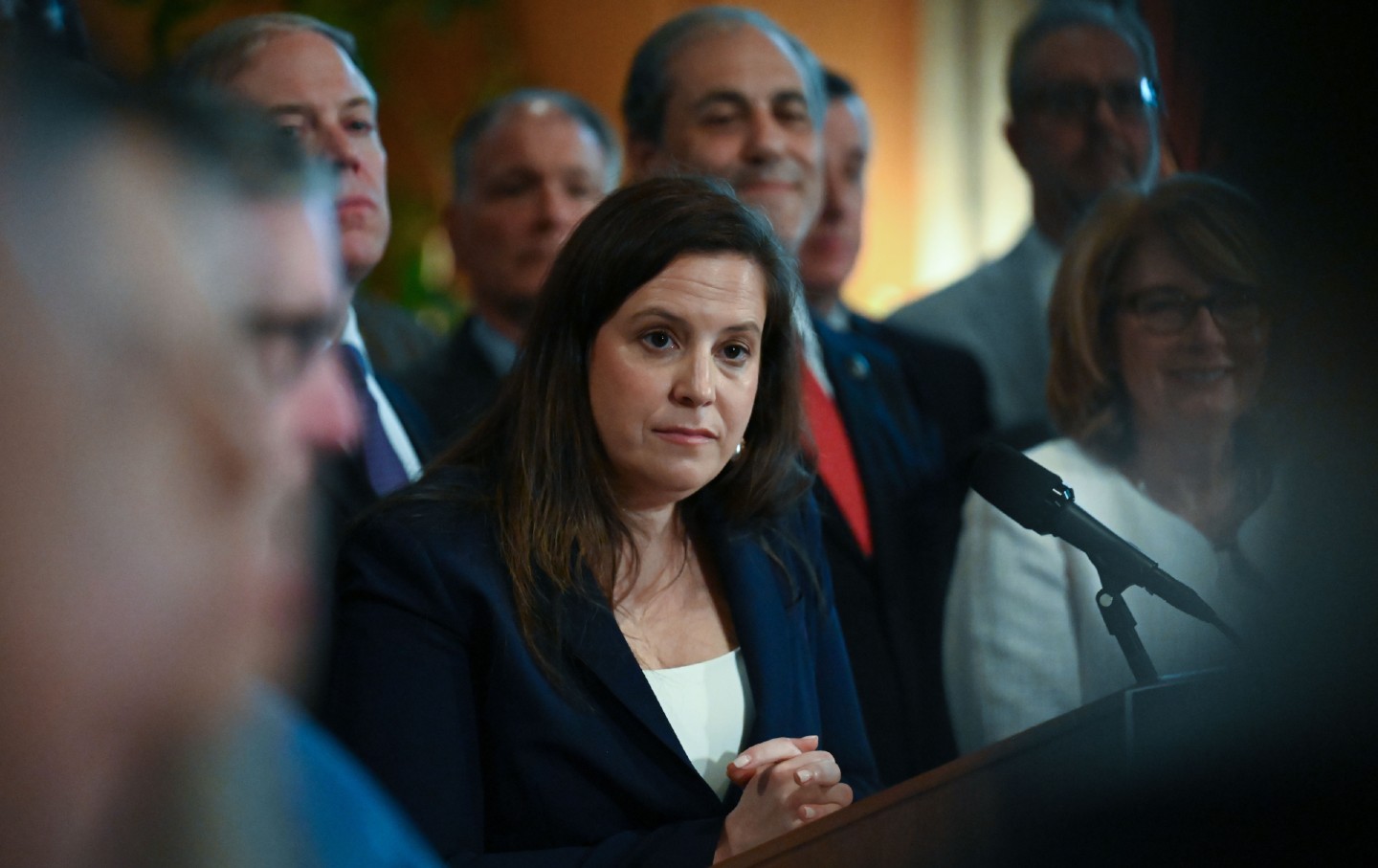
Elise Stefanik is just the latest top Republican deciding against running in the 2026 midterms.
John Nichols

Donald Trump escalates Caribbean tensions with vessel attacks near Venezuela.
OppArt
/
Felipe Galindo
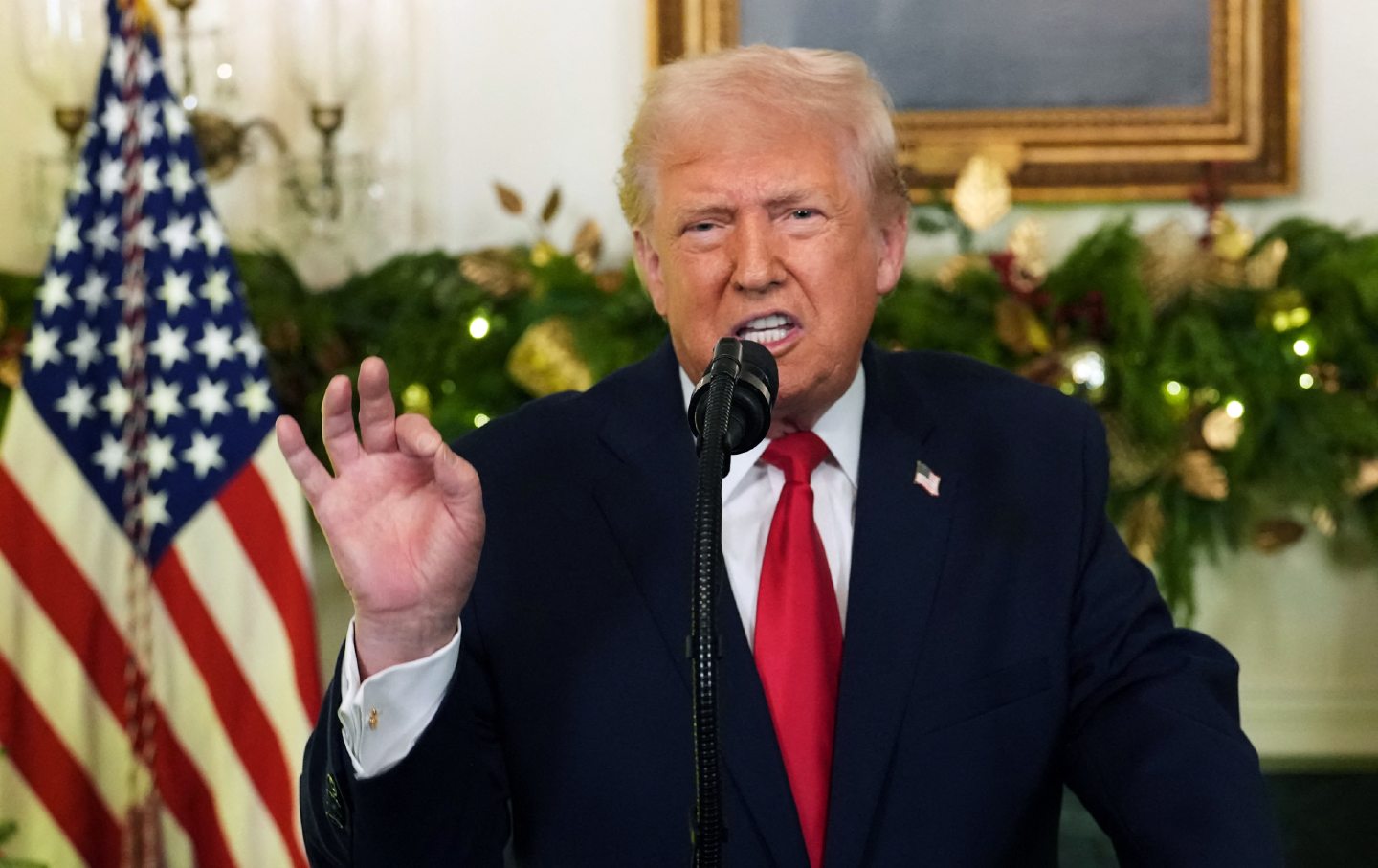
This week’s “Elie v. US” explores the authoritarian threat beneath Trump’s bonuses for military families. Plus, a case for getting rid of the Second Amendment.
Elie Mystal