


Sea stars were the inspiration for the “keystone species” concept: creatures without which healthy ecosystems collapse.
When sea stars are threatened, their whole environment is imperiled. Sea stars were the original inspiration for the “keystone species” concept: creatures without which healthy ecosystems collapse. In the 1960s, experiments showed that thriving tide pools became overrun by mussels if ochre stars were removed. Sunflower stars are so good at keeping voracious sea urchins in check that, without them, regions can transform to “urchin barrens” — rocky wastelands devoid of any life, including the kelp forests that provide food and shelter for many fish.
The rise of environmental stressors — including pollution, lowered ocean oxygen levels and warming water temperatures — is thought to be making marine life in general more vulnerable to disease. “It’s like us, when we’re not sleeping, we’re way more likely to get a cold,” says Melissa Miner, an ecologist who works with Raimondi. The oceans have warmed about 1 degree Celsius since preindustrial times, and that uptick may lie behind an increase in reported diseases in urchins and corals. It’s surely stressing sea stars, too, says Miner.
To tackle future outbreaks of sea star wasting, researchers need to know its etiology. But the hunt for the cause has been like a winding murder mystery, with dead ends, red herrings, a suspect fingered then exonerated. This summer, researchers put another suspect in their sights: a bacterium with a long rap sheet for causing illness in both people and marine life. But the case, they say, is still far from closed.
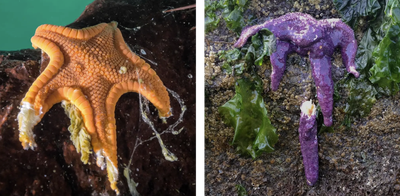
Left: A cookie sea star near Calvert Island, British Columbia, with signs of wasting disease. Right: An afflicted purple ochre sea star near Vancouver Island, British Columbia.
Grant Callegari / Hakai Institute; Steve Rumrill / Oregon Department of Fish and Wildlife
Chasing down the cause of a marine epidemic is often tricky. Seawater is swimming with all kinds of bacteria and other microbes. During an outbreak, there is often a lack of healthy or unexposed creatures to use as comparisons. Viruses can’t be bred in isolation, making it hard to do cleanly controlled experiments. And oftentimes, little is known about the biology of noncommercial species, such as sea stars, including which bacteria normally live on healthy specimens.
Back in 2013, Raimondi, with Ian Hewson at the Cornell Marine Mass Mortality Lab, in Ithaca, New York, and colleagues, began investigating the cause of sea star wasting. When they examined slices of flesh from symptomatic stars under the microscope, they saw no specific bacterial infection. Genomic analysis, on the other hand, turned up a type of virus called a densovirus, which had been detected in Hawaiian sea urchins the year before. Hewson ground up diseased tissue and filtered out anything bigger than a virus, then injected the viral broth into healthy stars: They wasted away. The whodunnit seemed solved.
The research team published its results in November 2014, drawing much attention from the scientific community, the press, and the public. But niggling questions remained. Tests found more and more densoviruses in normal sea stars, and further experiments trying to infect sea stars were inconsistent — some got sick, others didn’t. They had done good science, says Raimondi, but the team eventually realized “we were wrong.”
As scientists probed for causes, more outbreaks were popping up, including in China, Australia, and even Antarctica.
What else could it be, they wondered. Protists, or fungi? Maybe it was more than one disease, or not an infectious disease at all. The pattern of spread was odd: Infectious diseases don’t normally hit so many species all at once, nor jump distances of thousands of miles. Maybe the lesions were caused by something environmental. There had been no regional marine heat wave when wasting was first seen, in the summer of 2013, but a particularly epic heat wave did begin that October and grew in size and scope in 2014 as the disease continued.
Hewson and his colleagues tried drying out stars in the sun for an hour, lowering water flow rates in tanks, and even rubbing the stars to replicate overcrowding. Everything seemed to cause wasting. Meanwhile, more outbreaks were popping up, including in China, Australia, and even McMurdo Sound, Antarctica.
With funding from The Nature Conservancy, Alyssa-Lois Gehman, a marine disease ecologist with the Hakai Institute in Vancouver, and Melanie Prentice, an evolutionary ecologist at the University of British Columbia, picked up the case with colleagues in 2020. They worked on it for years, primarily with hard-hit sunflower stars. The hunt, they knew, wasn’t hopeless: Other marine epidemic cases were being solved. Withering abalone syndrome, for example, was traced to a bacteria called Candidatus Xenohaliotis californiensis. And, in 2022, Hewson’s lab pinned a massive die-off of long-spined sea urchins in the Caribbean on a eukaryote called Philaster.
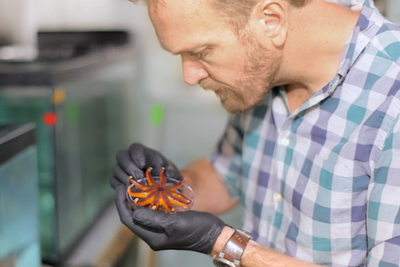
Cornell microbiologist Ian Hewson examining a sea star.
Cornell University
Prentice and colleagues started by grinding up sick sunflower stars, filtering the slurry, and isolating the part that would contain any tiny viruses. But introducing those viruses to healthy stars, they found, did not make them sick. Genomic analyses of tissue samples were complicated and unclear, but when they looked specifically at coelomic fluid — the “blood” of sea stars — a clear difference between sick and healthy stars leapt out: a strain of the bacterium Vibrio pectenicida called FHCF-3. When they grew this bacterium and introduced it to healthy stars, they died.
For many, this was a slap-on-the-forehead moment. The Vibrio group contains well-known bad actors, including the bacterium that causes cholera in people and others that cause die-offs in shellfish and fish. The pathogenic members of the group also, generally, thrive in warmer water. “I think the evidence they have is pretty compelling,” says Lauren Schiebelhut, an evolutionary ecologist affiliated with the University of California, Merced, who was not involved with the study.
But while this Vibrio appears to be involved, not all researchers are convinced it’s the key. Hewson, who didn’t respond to interview requests for this article, published a response paper noting that this particular strain wasn’t detected in other species of sick stars, so it “cannot be the cause of all” wasting. Plenty of researchers would like to see the work replicated in other species; Gehman says that is ongoing.
Sunflower stars are failing to grow to their previous sizes, and some tiny six-armed stars are completely gone in some areas.
Hewson and Raimondi also think the Vibrio might be a secondary infection rather than the cause of disease. Think of AIDS, explains Raimondi: People who die from this syndrome often succumb to a bacterial infection, but it’s the HIV virus that’s ultimately to blame. Hewson had seen Vibrio bacteria in both his urchin study and his work on sea stars but largely viewed them as opportunistic bugs feasting on compromised tissue. What lets the bacteria take over, says Raimondi, is as yet unknown.
It is a chicken-or-the-egg situation, agrees Melissa Pespeni, who studies the ecology and genomics of marine invertebrates at the University of Vermont. What we need to figure out, she says, is what’s “the additional stressor that is now allowing these Vibrio to become so pathogenic.”
“There’s still a lot of questions,” says Schiebelhut. “Was it there in the environment before? Is there some mutation involved? I’d like to see a lot more analysis of the pathogen itself and experiments in other species. But right now, this is the strongest evidence that we have for a pathogen.”
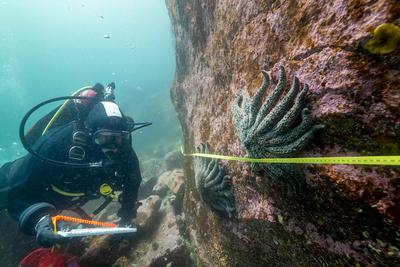
Ecologist Alyssa Gehman studies sunflower sea stars in Burke Channel, British Columbia.
Bennett Whitnell / Hakai Institute
Today, ochre sea stars have largely bounced back from wasting. In fact, they went into a baby-making frenzy when the epidemic struck in 2013, says Schiebelhut, at up to 300 times their previous rate of reproduction. The post-epidemic babies’ genetics are more similar, she says, to adults that survived the onslaught, hinting that they’re now more resistant.
Miner says there’s no concern about ochre stars going extinct, though there are far fewer now than before 2013. Sunflower stars, however, are failing to grow to their previous large sizes, she says. And some tiny six-armed stars are completely gone from some areas. “Who knows when or if they’ll ever come back,” Miner says.
Marine treatments are possible, if tricky. Some corals, for example, are being experimentally treated with probiotics to fight off suspect bacteria behind stony coral tissue loss disease – either by putting a bag around a coral and injecting the probiotic into the contained water or by smearing probiotic paste onto coral lesions – with variable levels of success. Something similar could in theory be done for, say, a critical patch of sea stars in an important kelp forest. Researchers are also hunting for a phage — a virus that affects bacteria — that might tackle this Vibrio. (Biologists have found one that naturally helps wild abalone resist withering from Candidatus bacteria.)
Researchers are trying to pin down genes that protect sea stars from wasting so breeding programs can select for them.
A parallel idea is to make sure that aquarium specimens are as robust as possible, to serve as a backup in case of disaster. Several facilities, including the nonprofit Sunflower Star Laboratory in Moss Landing, California, are breeding sea stars with the hope of transplanting them to help suffering populations recover. Sea stars in aquariums are now treated with antibiotics or probiotics, cool water baths, and extra oxygen when they show signs of stress or disease, says Martin Haulena, director of animal health at the Vancouver Aquarium.
Others, including Schiebelhut, are trying to pin down genes that help protect sea stars from wasting so targeted breeding programs can intentionally select for them. But that can be a risky game, says Pespeni, since overcoming the next assault could require a different genetic makeup.
In general, cooler waters seem to keep disease at bay. There are cool fjords in British Columbia, for example, says Gehman, where sunflower stars are still thriving. We need to do “whatever we can do to slow global climate change and slow pollution,” says Pespeni. “You can treat locally and hopefully help in an acute situation. But if it happens again the next week, or if whatever the stressor or pollutant is that’s causing it doesn’t go away, then it’s a lot of time and energy and money for treatment that’s not a long-term solution.”