


The local bobby is a quintessentially British idea, conjuring up images of a blue-coated, paternalistic individual who helps people with their problems and keeps the King’s peace. It speaks to a nostalgic longing for a type of policing that, although it probably never existed, is rooted in localism.
So deeply is it embedded in the collective British psyche that such a style of policing has been portrayed on television in shows such as Dixon of Dock Green, Heartbeat and, arguably, even The Bill.
What united these dramatic portrayals of policing in England and Wales was how the police officers intimately knew the geographic location they were policing, were on first-name terms with the people who lived there and would, if common sense dictated it, use their discretionary powers to resolve low-level offending in a way that would not have a negative effect on the community or its individuals.
This was not our modern idea of community policing, which has an amorphous and hard-to-define concept of what community actually means. Instead, this was a place- and people-based community of which the police officer was intrinsically both protector and member.
How traditional local policing worked
While this idealised version of policing probably never actually existed, something close enough did from the 1950s to the 1990s (and possibly even into the early 2000s in some counties) before it started to decline.
Some of this change was politically driven, with long-term effects from Thatcher’s use of the police to break strikes, police actions against poll tax rioters, race riots and Blair’s tough-on-crime stance all slowly eroding that essential link between place-based policing and the trust the public places in the police.
Some of it was also technologically driven: As cars entered policing, officers spent less and less time on the streets and became physically separated from those they were meant to know.
When we add the huge reductions in force capabilities driven by austerity from 2008 onwards, the model of policing in modern-day England and Wales is very different from the one we all carry in our minds.
Against such a backdrop, the decision to introduce Police and Crime Commissioners in 2011 seemed like an attempt to place localism back at the heart of constabularies. Here would be a locally elected civilian who could hold Chief Constables to account and set force priorities by controlling the police budget. The election cycle would allow local people to pick candidates who could take their views into policing, returning place and people to the heart of law enforcement.
However, this has not come to fruition. Instead, PCCs have been a decade-long example of how to waste public money.
Why PCCs have fallen short
High costs for limited impact: There are 42 Home Office police forces in England and Wales and 37 PCCs (other elected individuals cover this role in London, Greater Manchester, West Yorkshire, South Yorkshire, North Yorkshire and York). Those 37 PCCs each draw an average salary of £73,000 and employ a range of staff. Add in operating costs and this equates to millions of pounds a year taken from the budgets of police forces. In a time of shrinking public expenditure, this seems hard to justify.
Low voter turnout and weak democratic mandate: The democratic mandate of PCCs is questionable, as turnouts in their elections have been tiny. As an example, take the West Midlands Police area, which has approximately two million eligible voters for PCC elections. At the last PCC election only 595,000 people turned out to vote (29 per cent), and the winning candidate took a little over 15 per cent of that total. So instead of having somebody who represents local people, the West Midlands arguably has a PCC who represents a tiny minority of those being policed.
Questionable effectiveness and political influence: While some of the 37 have been very professional, many are best described as the archetype of the English amateur – people who have a passing knowledge of the topic but who are not deep experts in the field. This has led to some dubious activities carried out in the name of crime prevention or public engagement. One example was the Durham PCC Joy Allen, who spent £50,000 on a VW van to drive around the county engaging with the community, a technique that is of questionable value when the public would clearly prefer a police constable on foot patrol to be their point of engagement.
PCCs were originally supposed to be independent of political influence. This ideal quickly disappeared, with the major parties supporting individual PCCs at the first election cycle. Rather than champion local issues, PCCs became wrapped up in national politics, which do not always match what is needed in a local policing context. Individuals who had been councillors or had failed in attempts to become MPs began to run for the roles, raising questions about their genuine interest in policing versus their political ambition.
Rethinking local policing
Many criticisms of PCCs can also be laid at the feet of mayors or other elected officials. While the end of the PCC regime is welcome, there is hesitation about what comes next.
Ultimately, police forces have professional leaders – Chief Constables – who report to the Home Secretary. Perhaps the best answer is to revert to this model of quiet professionalism, with Chief Constables taking ultimate responsibility locally and the Home Secretary holding oversight nationally.
Remove the politics and focus on delivering the street-level, accessible and place-based policing that the public desires.
John Bahadur Lamb is an Associate Professor of Policing in the Institute of Policing at the University of Staffordshire.
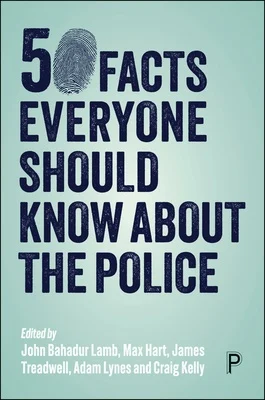 50 Facts Everyone Should Know About the Police edited by John Lamb, Max Hart, James Treadwell, Adam Lynes and Craig Kelly is available for £16.99 on the Bristol University Press website here.
Bristol University Press/Policy Press newsletter subscribers receive a 25% discount – sign up here.
Follow Transforming Society so we can let you know when new articles publish.
The views and opinions expressed on this blog site are solely those of the original blog post authors and other contributors. These views and opinions do not necessarily represent those of the Policy Press and/or any/all contributors to this site.
Image credit: Dylan4photography via Unsplash