


Activism
/
January 16, 2026
Formed to oppose the Iraq War, Madres Contra La Guerra have now spent decades trying to end Puerto Rico’s role at the center of the US war machine in Latin America.
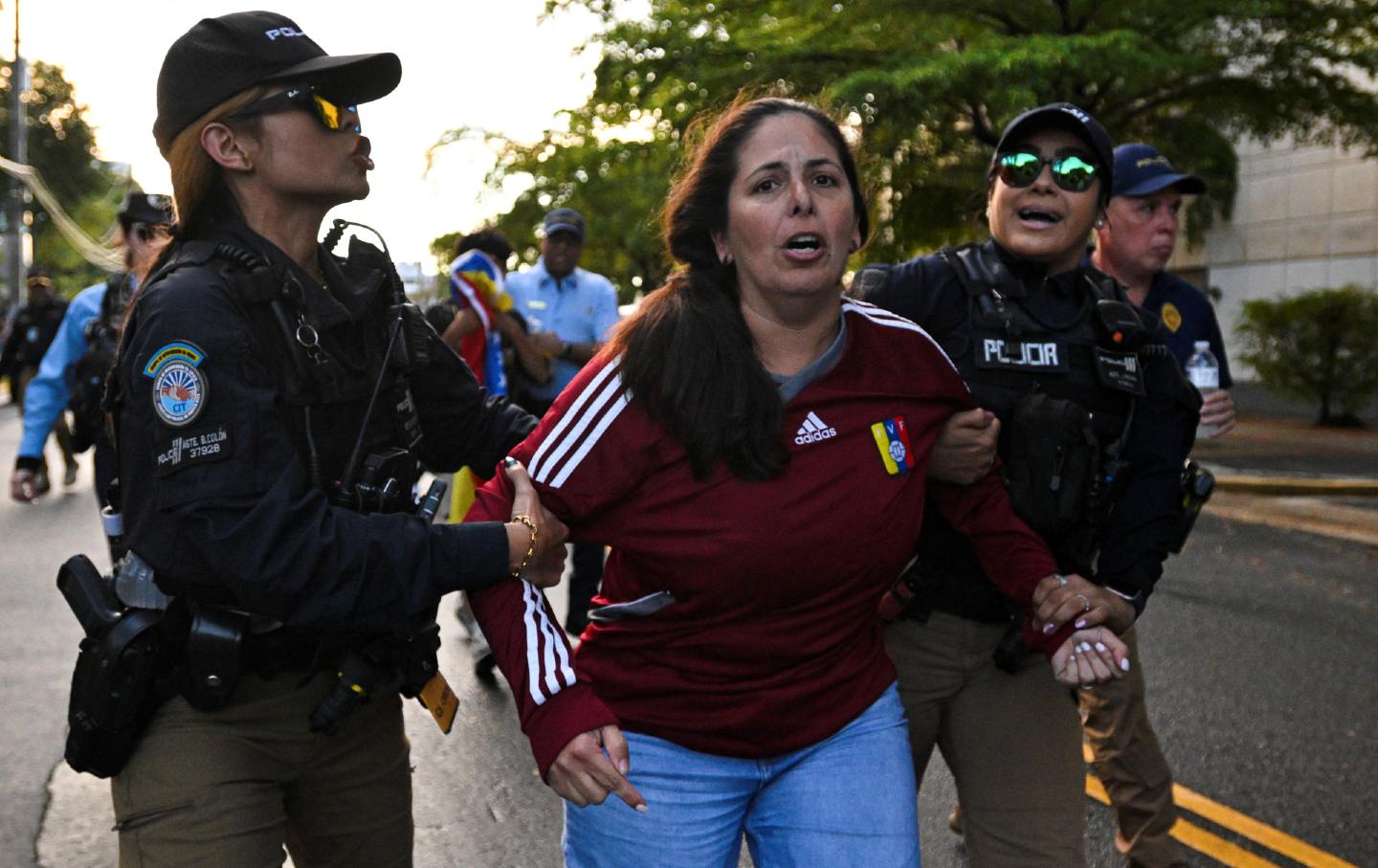
A protester is detained as demonstrators rally against US military intervention in Venezuela in San Juan, Puerto Rico, on January 3, 2026.
(Miguel J. Rodriguez Carrillo / AFP via Getty Images)
In a blurry black-and-white Polaroid from 1971, Sonia Santiago Hernández reenacts an image of the Madonna and Child. Only 21 years old, she wears a miniskirt and sandals, and oversize sunglasses sit perched on her forehead. She stands in contrapposto outside the University of Puerto Rico Rio Piedras in San Juan, gazing serenely at her newborn son Gabriel. Since his birth, Gabriel had been her companion at every Vietnam War protest that she attended, shuffling between student comrades who took turns holding him. In the months before her pregnancy, Santiago had been on hunger strike for 26 days.
On a colonized island where one-third of all Puerto Rican women had been forcefully sterilized from the 1930s to the ’70s, holding the baby for a photo felt like an act of resistance. Gabriel was raised in a house plastered with peace-sign magnets, pins, posters, and stickers—his playpen devoid of toy guns or weapons.
“Maternity is life,” Santiago told me. “War is death. We fight for peace.”
In 2003, the United States invaded Iraq, and Puerto Rico became overrun with military recruiters. Lurking in malls, colleges, and other youth haunts, they promised financial benefits and opportunity for those who enlisted. More than 38,000 Boricua youth were deployed—including Gabriel.
Current Issue
Santiago’s grief and devastation at her son’s involvement in US war led her to found Madres Contra La Guerra, or Mothers Against War, in May 2003. When the United States attacked Venezuela and abducted Nicolás Maduro on January 3, killing 80 people in the process, Santiago saw Iraq’s history repeating itself. She found herself ridden by the same indignation. “Once again, they are trying to justify their aggression under the rhetoric of narcotrafficking, falsely attributing the origin of drugs in the region to Venezuela,” Santiago said in a Madres’ press release, recalling the threat of weapons of mass destruction that convinced her son to enlist in Iraq. “This is a fabricated narrative designed to cover up a war of plunder.”
After waking up to the news in Caracas, Madres coordinated a protest with the Venezuelan Solidarity Network outside of the federal building in San Juan. Their message, beyond an end to the escalation, was directed at Puerto Rican youth soldiers: Don’t become accomplices to the war on Venezuela.
The attacks of January 3 did not surprise Santiago and other Puerto Ricans, who over the last several months had seen military training exercises take over their public beaches. Since the United States sank the first Venezuelan ship in early September, the supposedly dormant Roosevelt Roads naval base in Ceiba came back to life. The last few months brought the largest military ramp up in the Caribbean since the 1994 invasion of Haiti. Ceibeños often hear the deafening noise of the fighter jets. Their silverware trembles and their lamps shake as F-35s, V-22 Ospreys, and UH-60 Black Hawks roar overhead. Some 15,000 US soldiers have been garrisoned at the base.
Long before the US started its war games with Venezuela, Puerto Rico had operated as the linchpin of the US invasions in the region. In 1954, US militia invaded Guatemala from the Ramey Base in Aguadilla as part of a coup against President Jacobo Arbenz, whose agrarian reform threatened the profits of the United Fruit Company. In 1965, US troops trained in Roosevelt Roads were sent to the Dominican Republic following the overthrow of Juan Bosch. In 1983, Puerto Rico served as a staging ground for the US invasion of Grenada, and again for the 1989 invasion of Panama. Maduro’s first stop on his way out of Venezuela was through Aguadilla. In the now-viral image of Maduro in a gray Nike Tech jumpsuit, he clutches a Nikini water bottle, a brand sold in Puerto Rico.
Santiago notes that the invasions that preceded the attacks on Venezuela were also a reflection—not of “manifest destiny” but of US economic and geopolitical interests. “They are using this invasion to guarantee forced access to their resources, the oil and natural resources that belong to the Venezuelan people.” Venezuela has the world’s largest proven oil reserves, which will now trade exclusively with the United States.
What began as an anti-recruitment group advocating for conscientious objection to the Iraq War became an organization devoted to peaceful civil disobedience. Since its inception, the group’s protests have shut down the entry points of prominent recruitment centers and military bases. Madres’ coalition of 200 families formed part of a broad anti-military resistance in Puerto Rico, which, in addition to protesting the Iraq War, was trying to push the US military out of Vieques.
Vieques is a tiny appendage off the eastern coast of Puerto Rico that housed the Vieques Naval Training Range, the construction of which displaced 10,000 Viequenses. The US military used the base to perform countless experiments with toxic weapons, including agent orange, napalm, white phosphorus, and heavy metals. In 1999, a bombing accident killed a local security guard, David Sanes Rodriguez. That year, activist and Independence Party president Rubén Berríos began a year-long civil sit-in at the navy’s high-impact zone, sparking a wave of fierce opposition. A few years later, Vieques closed; along with it, the Roosevelt Roads Naval Base, once one of the largest bases in the world.
The media often uses the word “remilitarization” to describe the situation in Puerto Rico.Santiago rejects that characterization. “It’s not ‘remilitarization’; it’s reactivation,” she said. “They’re doing the same thing they always did. They were just passive for a while. But they never left.”
The “passive” period that Santiago mentions was filled with broken promises. When the military shuttered Vieques, it promised a cleanup, but thousands of acres remain contaminated. Cancer rates are 30 percent higher in Vieques than on the rest of the island. Fort Allen, Camp Santiago, and Fort Buchanan never closed. Nor did the Muñiz Air National Guard Base in Carolina, where Defense Secretary Pete Hegseth spouted made-up propaganda about a fictional Venezuelan drug cartel.
Immediately following the January 3 attacks on Venezuela, the US military held “Army of the Caribbean Week ’26” at Fort Buchanan. It is the first event of its kind, and it involved deploying thousands of troops and beefing up military equipment for a week of training in a “commitment to duty and readiness in the Caribbean.” Press releases about Army Week are vague, intentionally distanced from Venezuela, but Trump warned that he could target Colombia, Cuba, and Mexico next. If that happens, it’s more than likely that Puerto Rico will again be the staging ground.
The strikes on Venezuelan ships came from Roosevelt Roads, and it led Madres Contra La Guerra to block the entry to the base for the first time in 20 years. Now 67, Santiago leads a group of mothers, elders, and youth in a bus en route to Ceiba. She wears red lipstick and a black peace-sign T-shirt that reads, “War is the Antithesis of Life.” Over the clamor of helicopters, the Madres chant, “Basta ya, basta ya, No a guerra criminal”—“Stop it now, Stop it now, No to criminal wars”—to the percussive rhythms of bomba (ironically and unrelatedly, Spanish for “bomb”). Accompanying the protesters is a group of drummers, Tambores Por Palestina.
A central tenet of the Madres’ philosophy is solidarity with other colonized countries and mothers. It began with Iraq and has now extended toPalestine and Venezuela. Every Tuesday since October 2023, Madres can be found wearing keffiyehs outside the Israeli consulate in San Juan leading the islands’ most prominent anti-genocide protests. Their visibility has earned Madres multiple visits from the FBI. Yet they remain unflinchingly vocal about the shared colonial struggle of Palestine and Puerto Rico, swinging both flags in communion.
Similarly, Madres often refer to Venezuela as a “sister country.” “We understand that Venezuela, like every Latin American country, is being accosted by US imperialist interests,” Santiago said. “But beyond that, there’s an enormous cultural and linguistic affinity between us, a shared history of liberation struggles.” Santiago references Simón Bolívar in Venezuela and Ramón Emeterio Betances in Puerto Rico, whose cries for independence reverberate through present decolonial movements across the island.
Popular
“swipe left below to view more authors”Swipe →
A significant element of Madres activism is fighting for restitution for the 1898 Treaty of Paris, the agreement that handed over Puerto Rico, Cuba, Philippines, Hawaii, and Guam to the United States after the Spanish-American War and made them de facto military colonies. Santiago sees the treaty as the origins of Puerto Rico as a colonial war laboratory. “It’s important to emphasize it, denounce it, and demand reparations. They need to return those lands on a national level,” Santiago said. “Those aren’t Roosevelt’s roads, those are the roads of my people, the Ceibeños. They steal land and then name it after themselves. It’s not right.”
Santiago still speaks of motherhood with reverence and affection. She claims it is the undercurrent of her solidarity and her struggle for peace. “When you create life, you’re not thinking that you will raise them to kill or be killed,” she said, evoking her son Gabriel, now a veteran who struggles with PTSD. “That thread of maternity can be extrapolated not only onto your child, but for all of humanity.”
Her words echo the sentiments of “militant mother” movements across Latin America—Madres de la Plaza de Mayo in Argentina and Madres Buscadoras in Mexico. Santiago and some of her peers have travelled to Argentina. They’ve broken bread with mothers in Mexico, Guatemala, and El Salvador and accompanied them in their grief and sense of political possibility. Santiago maintains that the maternity knows no border.
There’s anger, frustration, and indignation embedded in mothers’ movements like Madres Contra la Guerra. Yet Santiago stressed revolutionary kindness above all. “Maternity is derived from tenderness and love. Solidarity is tenderness between communities,” she explained, recalling Venezuela, Palestine, and her own children. “It’s really simple. It’s philosophical, yes, but it’s actually the simplest feeling there is.”