


Celebrating its 100th anniversary this February, Black History Month is a fitting moment to remind ourselves that capitalism’s disreputable trajectory has been and continues to be a deeply racialised one. At its core, capitalism functions by assigning value to nature, objects and people. And race has systematically played a powerful role in this valuation process.
While whiteness has invariably been held in high esteem and therefore retains considerable value, bodies of colour have historically been devalued while simultaneously remaining crucial to capitalism’s survival and expansion.
Chattel slavery as the foundation of racial capitalism
Nothing exemplifies the brutality of racial capitalism as much as the chattel slavery that was practised in much of the so-called ‘New World’ from the early 17th to the late 19th century. While images of Black bodies toiling in cotton, tobacco and sugar-cane fields are familiar to many of us, we are less conversant with the widespread use of enslaved bodies as human capital.
Legally recognised as tangible property, slaves possessed not only use- but also exchange-value, since they could be bought and sold in the open market, bequeathed as wealth to the children of slave owners and used as collateral whenever necessary.
An intriguing paradox is in play here, namely that Black men and women were devalued when it came to their humanity – regarded as inferior and lesser human beings – while also being recognised as valuable assets and property.
How slavery created enormous White wealth
This storage of value in enslaved Black bodies made an entire capitalist class with ownership interests in the plantation system enormously wealthy, even putting them into a bracket of the richest people in the world.
These elites were by no means the only people to reap the benefits of chattel slavery.
By the early 1800s, White working-class men and women in Britain along with members of the petit bourgeois (schoolteachers, milliners, grocers etc.) were investing a fair amount of their savings in the various ships plying the slave trade and making reasonable amounts of money when the ships reached safety ashore.
The slave trade was thus partly responsible for injecting a degree of socioeconomic mobility into the British class system of that time.
Slavery’s role in the rise of industrial capitalism
Chattel slavery made more than some sections of the White population wealthy. Gargantuan profits from the slave trade and the plantations became the backbone of industrial capitalism, directly funding much of the early factory system and enabling the rise of mass production.
In addition, certain industries in Britain, France and the Netherlands were strongly boosted by the needs of the plantation economy and the Atlantic slave trade.
Shipbuilding was one of them, since the trade needed vessels that could hold hundreds of shackled slaves along with large cargoes of finished goods intended for the American and Caribbean markets. Entire cities like Bristol, Lancaster, Liverpool and Glasgow became prosperous urban centres mainly because of the spectacular growth of their shipbuilding enterprises.
The insurance industry was another direct beneficiary of the slave economy. Slave owners and investors were looking for ways to ensure their invaluable human capital against disease, injury and death, and the insurance industry was more than happy to oblige. Firms like Lloyds of London, New York Life and Harford Life made large fortunes by selling policies to slave owners and traders, safeguarding their human possessions from a number of potential external threats.
Slavery thus racialised capitalism through its enduring symbiotic relationship to it.
The afterlife of slavery in modern capitalism
Sadly, slavery’s eventual demise failed to end capitalism’s toxic relationship with racism. As capitalism transformed, reinvented itself and entered new geographic spaces, it continued to draw Black and Brown populations into its hyper-exploitative ambit.
Jumping forward by more than a century, we still find large populations of colour working in conditions that are not that far removed from the cotton fields of 19th-century Virginia and Mississippi.
The processing of electronic waste (e-waste) that takes place mostly in the fringes of many large cities in Asia and Africa exemplifies some of the worst working conditions of the 21st century. Contemporary capitalism revolves around advanced information technology and a digital economy that makes personal computers, laptops, tablets and cell phones indispensable to the lives of most people.
These electronic items are consumed and discarded at an unprecedented speed, eventually ending up in designated landfills in China, Ghana, Pakistan, India and Kenya. While China is a major contributor (in sheer volume) to e-waste accumulation, the major per capita generators of e-waste are the US (8 million tonnes per year) and the EU (10 million tonnes per year).
From cotton fields to toxic dumps: The dawn of digital capitalism
Capitalism is no stranger to the creation of waste. In its quest for inexhaustible profits, capitalism has irreparably damaged our air quality and dumped toxic waste all over the planet. There is something different, however, about e-waste because of the substantial value of the metals contained in it. The extraction of copper, silver, platinum, cobalt, lithium and nickel from discarded electronic products is an $80-billion-dollar industry. Migrants, children and other destitute workers endlessly toil in the informal economy that has grown around this process. With little to no regulatory oversight, they sift through mountains of hazardous waste, often using their bare hands to extract the precious metals. Agbogbloshie in Ghana has the dubious distinction of being the e-waste capital of the world. Other major sites include the Old Seelampur neighbourhood in Delhi, Dandora in Kenya, Yaoundé in Cameroon and the fringes of Lahore and Karachi in Pakistan.
Health hazards generated by these toxic landfills are beyond appalling and affect both the people working in them as well as those living around them.
18 million children between the ages of 5 and 17 work in some form of metal extraction and e-waste processing. They suffer from a range of respiratory diseases, impaired neurological development, autoimmune conditions and the risk of fatal chronic illnesses later in life.
In addition, lead and cadmium have been leaking into the soil for several years, turning surrounding neighbourhoods into disease pits with shocking increases in thyroid malfunctions and various forms of cancer.
Why capitalism cannot be challenged without challenging racism
As capitalism took a digital turn and remained committed to fostering a throwaway culture, it created this horrendous calamity in the first place. At the same time, it also sheltered most of the White world from the worst ravages of electronic waste by offloading the bulk of it into places where hapless Black and Brown populations are compelled to take care of it.
We often allow ourselves to be taken in by the myth of progress, which tells us that working conditions of men and women across the planet have steadily improved over time. That is clearly not always the case. One of the lessons of Black History Month is not simply that racial capitalism has a long past but that it has an uninterrupted present. Any challenge to global capitalism must therefore go hand in hand with efforts to dismantle the racism that is foundational to it.
Pushkala Prasad is the Zankel Professor of Management in the Department of Management and Business at Skidmore College.
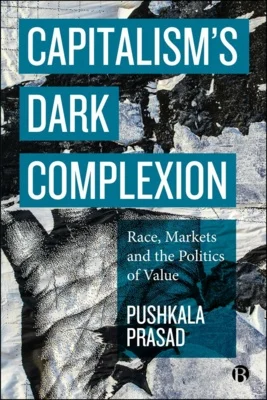 Capitalism’s Dark Complexion by Pushkala Prasad is available for £29.99 on the Bristol University Press website here.
Bristol University Press/Policy Press newsletter subscribers receive a 25% discount – sign up here.
Follow Transforming Society so we can let you know when new articles publish.
The views and opinions expressed on this blog site are solely those of the original blog post authors and other contributors. These views and opinions do not necessarily represent those of the Policy Press and/or any/all contributors to this site.
Image credit: Wikimeida – No known copyright restrictions.