


by
Gurminder K Bhambra
3rd March 2026
In an interview in The Paris Review in 1994, Chinua Achebe, the Nigerian novelist, quoted an African proverb: ‘Until the lions have their own historians, the history of the hunt will always glorify the hunter.’ This aphorism neatly captures some of what is at stake in terms of how histories of empire and colonialism are remembered, and the difference that remembering them makes to how we think about the modern world.
Standard accounts within the social sciences present the emergence of the modern world in terms of the political and economic transformations associated with the US and French Revolutions and the Industrial Revolution in Britain. Political revolutions are related to the institutions of the modern nation state and democratic sovereignty; the Industrial Revolution is regarded as central to a developing capitalist economy and its class relations.
These events tend to be understood as emerging and developing as a consequence of events and processes internal to the societies with which they are associated. The rest of the world is regarded as external to these world-historical processes, and longstanding colonial connections are presented as insignificant to their development. Yet, as I have argued, each of these revolutions was embedded within wider colonial contexts that have been written out of social scientific accounts of modernity.
It was precisely to address such lacunae that, in 2020, with Amit Singh and Ishan Khurana, I set up the Connected Sociologies Curriculum Project, which was generously funded by the Sociological Review Foundation. This project brought together a variety of academics to reconsider key social science concepts and categories from perspectives that take colonial histories seriously, as well as to provide online resources for students and their teachers. To complement this online offering, together with Ipek Demir, Paul Gilbert, Su-ming Khoo and Lucy Mayblin, we have now co-edited a textbook for use by undergraduate students and those taking their A-levels.
The Modern World After Colonialism: Remaking the Social Sciences starts from the significance of colonial histories in the making of the modern world. It brings together scholars who understand the challenges posed by arguments for transforming the curriculum and who mobilise those insights in their lectures and chapters, re-presenting core concepts and categories in the context of histories of colonialism and empire.
To give one example: The nation state is often presented as the primary political unit of analysis across the social sciences. Scholars present it as having emerged out of the French Revolution and developed across Europe as monarchic and aristocratic rule gave way to popular sovereignty. Its emergence is central to sociological understandings of modernity, involving a corresponding decline of empire as a political form. In this way, empires come to be located in the pre-modern past and nation states are seen to represent the modern present (and future). Yet, at the same time that Europe transforms into a territory of nation states, those states are also involved in the creation of overseas empires.
Nation states, then, do not come into being along with the decline of empires, but rather through the simultaneous emergence of empires. Within the overseas empire, sovereignty is denied and colonised populations are subject to dispossession and the appropriation of resources to the benefit of the colonising nation. Without taking empires and colonialism seriously, our understanding of the nation state (and its institutions) is limited to developments within its boundaries, rather than how its very boundaries and institutions emerged in the context of broader colonial histories. By locating the nation state within those histories, we have a more expansive basis from which to think through its development and organisation, including contemporary debates about immigration.
For example, it is frequently argued that welfare states represent the patrimony of past generations of national citizens, and migrants have a problematic and disputed claim to that patrimony. Yet past generations of colonial subjects have also contributed to that patrimony through processes of colonial taxation. Relatedly, the recent phenomenon of ‘raising the colours’ – the St George and Union flags hoisted across the country – fails to recognise as citizens those members of the empire who fought and died under those colours in two world wars and the many other campaigns of the British state.
To return to Achebe, as well as considering who gets to tell histories, there is also the related question – particularly significant to the social sciences – of how these histories are framed and structured. The failure to recognise the memories of others, and to make them a part of our histories, is associated with the power of a particular narrative – that of modernity, or the rise of the West more generally. It is only by situating analyses of the modern world within colonial histories and their legacies, as we seek to do within our book, that it is possible to provide a more adequate understanding of the past and how it continues to shape our present through to the future. It is only by remembering empire that we can rethink modernity and open up new possibilities for intervening more effectively in our present and shaping our future differently.
Gurminder K Bhambra is Professor of Historical Sociology at the University of Sussex.
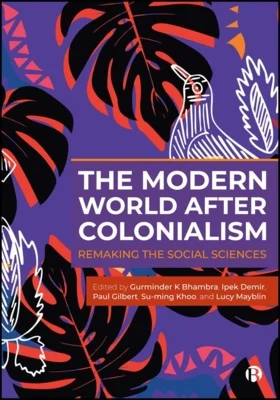 The Modern World After Colonialism edited by Gurminder K Bhambra, Ipek Demir, Paul Robert Gilbert, Su-ming Khoo and Lucy Mayblin is available for £19.99 on the Bristol University Press website here.
Bristol University Press/Policy Press newsletter subscribers receive a 25% discount – sign up here.
Follow Transforming Society so we can let you know when new articles publish.
The views and opinions expressed on this blog site are solely those of the original blog post authors and other contributors. These views and opinions do not necessarily represent those of the Policy Press and/or any/all contributors to this site.
Image credit: Shepherd via Unsplash