


Should the Supreme Court agree with the EPA, no future administration could use the Clean Air Act to regulate greenhouse gases.
Every president committed to climate action has recognized the Clean Air Act’s value, but also its limits. And while bold climate legislation is unlikely to pass anytime soon, smaller efforts can still make meaningful headway. Now is the time to develop new ideas that could be acted upon when Washington’s political balance shifts.
The legal battle over the endangerment finding is underway, meanwhile, and is expected to reach the Supreme Court. The EPA’s case rests on three arguments: that the Clean Air Act authorizes regulation of only local and regional pollution; that U.S. vehicle emissions don’t meaningfully “contribute” to climate change given their small share of a global problem; and that Congress has not clearly enough authorized such a sweeping assertion of regulatory authority.
If precedent means anything, these arguments should fail. The Supreme Court rejected the same or similar claims in its 2007 decision in Massachusetts v. EPA, holding that greenhouse gases are pollutants subject to regulation under the Act and that Congress had spoken unequivocally. On the contribution question, the court found that the state of Massachusetts had standing because even fractional reductions of a global problem can ameliorate its harms — a point confirmed by science that shows that every ton of emissions contributes to the severity of climate impacts. And U.S. transportation emissions are far from fractional: They exceed the combined national emissions of Germany and Japan.
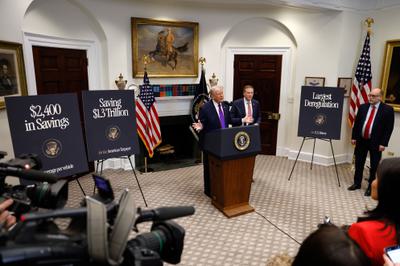
President Trump announces the repeal of the endangerment finding last month, with EPA Administrator Lee Zeldin and (far right) Office of Management and Budget Director Russell Vought.
Will Oliver / EPA / Bloomberg via Getty Images
Since that decision, the court’s composition has changed. None of the five justices who formed the Massachusetts majority are still there, while three of the dissenters remain — on a bench that has tilted notably to the right. The EPA is hoping for a sympathetic audience if the case reaches the high court.
It would be difficult to rule that the EPA lacks authority to regulate global pollution without directly or indirectly overturning the Massachusetts decision. The court is typically reluctant to overturn statutory precedents — Congress can always change the law — and subsequent decisions have built upon the 2007 case. In 2013, after the D.C. Circuit rejected several challenges to the endangerment finding, the court declined review.
Still, should the court agree with the EPA that it lacks authority here, no future administration could use the Clean Air Act to set greenhouse gas standards for even the largest U.S. emitters unless Congress amends the law, and all rules that depend on the endangerment finding would logically fall with it. That outcome might, however, open the door to federal litigation seeking remedies from power plants and oil companies for unregulated emissions over which the EPA now disclaims authority. That possibility may give the justices pause.
The Trump administration might win a lesser victory by convincing the court that it should have discretion to define what counts as a “contribution” to climate change and set emissions limits high enough that no subset of U.S. sources could meet the test. That argument should not succeed either, but even if it did, a future administration could reset the threshold and resume regulation.
The best near-term climate opportunity with growing bipartisan support is to pass legislation modernizing the U.S. power sector.
Notably, EPA’s final rule dropped its draft proposal’s argument that the science underlying the endangerment finding was insufficient. That claim rested primarily on a dubious report commissioned by the Department of Energy and written by five handpicked climate contrarians. The group hastily disbanded just before a federal court found it had been unlawfully convened. A new National Academies climate assessment flatly contradicted the group’s findings. EPA has since abandoned its frontal attack, but its remaining statutory arguments still rely on faulty science — including the unaddressed assertion that regulating small emissions shares is futile.
Regardless of what happens with the legal challenge, however, the U.S. needs additional strategies to curb our economy’s greenhouse gas emissions and manage climate impacts already being felt.
First, while earlier climate bills may have faltered or been clawed back, aspects of them may still be salvageable, like tax credits for wind and solar power and energy efficiency, which both Republicans and Democrats historically have supported. Members of Congress still like to direct spending to their constituencies, so restoring some clean energy incentives may be feasible over time.

Traffic in Los Angeles. Transportation is the largest source of U.S. emissions.
Kevin Carter / Getty Images
Larger steps are also possible. The best near-term climate opportunity with growing bipartisan support is to pass legislation modernizing the U.S. power sector. While some experts might be skeptical — power sector reform has languished for years — the combination of rising electricity costs, escalating demand, and aging infrastructure is creating new pressure for action.
An effective bill would need to expand the electrical grid to meet surging demand — from data centers and from buildings and vehicles that are shifting off fossil fuels — while controlling ratepayer costs and ensuring reliability. Wind and solar power backed by storage and energy efficiency can meet these goals. Renewables are now cost-competitive even without subsidies, and solar remains the fastest-growing source of generating capacity.
Part of the challenge is that permitting for new energy projects takes too long. Several congressional bills propose streamlining environmental reviews by shortening deadlines and reducing their scope, among other reforms. But compromise must come from all sides: The Trump administration, for instance, would have to ease its opposition to renewables on public lands and allow the fully permitted wind projects it has blocked to move forward. After the 2026 midterm elections, politics may shift enough to enable this kind of bargain.
There is also growing support for improving federal disaster response, which will be vital as floods, heat waves, and wildfires intensify.
Part of the challenge is that permitting for new energy projects takes too long. Several congressional bills propose streamlining environmental reviews by shortening deadlines and reducing their scope, among other reforms. But compromise must come from all sides: The Trump administration, for instance, would have to ease its opposition to renewables on public lands and allow the fully permitted wind projects it has blocked to move forward. After the 2026 midterm elections, politics may shift enough to enable this kind of bargain.
Renewables and other new energy supply also face significant obstacles to interconnecting with the grid. In 2023, the Federal Energy Regulatory Commission tried to reduce the backlog of projects in grid operators’ interconnection queues by revising the process to ensure that new generation, especially projects representing advanced technologies, could connect to the transmission system in a timely manner. That was a good start, but to move even faster we need new transmission lines and a plan to equitably allocate their cost. Grid regulators have struggled to get states and utilities to collaborate on new inter-regional transmission projects because of disputes over who pays and who benefits. But promising ideas to incentivize more cooperation and accelerate projects have circulated in Congress and could be part of a comprehensive deal.
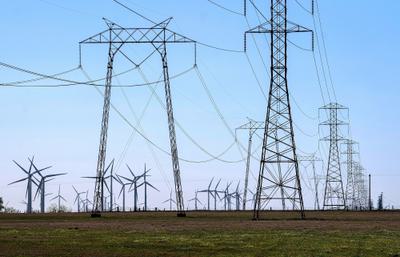
Wind turbines and transmission lines in Rio Vista, California.
David Paul Morris / Bloomberg via Getty Images
Meanwhile, red and blue states alike are piloting initiatives — retrofitting homes, expanding EV charging networks, and shifting to cleaner fuels, among other actions — without invoking the climate label, citing instead economic development, efficiency, or public health rationales. These experiments are worth tracking and learning from; they could serve as blueprints for regional or national policy.
We must also better manage climate impacts that affect us now. Few issues should attract more bipartisan support than immediate threats to local communities: In 2023 and 2024 combined, more than 50 separate billion-dollar weather disasters struck the U.S., causing roughly $182.7 billion in damage and untold suffering.
Congress’s 2021 infrastructure law responded to this reality, dedicating more than $50 billion to climate resilience — including loans and grants to help communities reinforce infrastructure or relocate from high-risk areas. In a positive sign, when the Trump administration’s FEMA tried to cancel some of these programs, a bipartisan coalition in Congress and the courts pushed back.
There is also growing support for improving federal disaster response, which will be vital as floods, heat waves, and wildfires intensify. These events don’t discriminate between Democrats and Republicans, and hard-hit communities need more help than states can provide. In 2025, disaster mitigation and recovery legislation passed out of a House committee on a 57-3 vote; the bill proposed elevating FEMA to a cabinet-level agency.
Even if the endangerment repeal holds, much of the oil and gas industry has signaled it wants to keep the methane rule.
Meanwhile, the Clean Air Act is still a good tool for controlling transportation sector emissions. The statute requires the EPA to consider cost and available technology and give manufacturers adequate time to comply — a framework that has improved public health, saved consumers money, and driven steady advances in cleaner cars. The most recent light-duty vehicle standards were projected to avoid 3.1 billion tons of CO2 emissions, reduce gasoline consumption by 360 billion gallons, and save consumers an average of $1,080 over the lifetime of a vehicle. The government has never told anyone what car to drive, but Clean Air Act rules have made the entire fleet cleaner and more efficient.
The law can also effectively regulate methane leaks from oil and gas facilities. The most recent methane rule, from March 2024, received praise for holding companies to consistent standards while allowing flexibility to test emerging technologies. Without a federal rule, states would set their own standards, creating a regulatory patchwork. Much of the industry has signaled that it wants to keep the methane rule even if the endangerment repeal holds, though it’s hard to see how since logically they’re tied together.
The Clean Air Act is the bedrock of U.S. climate regulation, but it cannot do the job alone. Addressing climate change requires tools to mitigate emissions, spur clean energy adoption, and manage the impacts already underway. The EPA’s effort to repeal the endangerment finding is unlikely to survive legal challenge. But regardless, we should be planning, developing, and building bipartisan support now for effective climate strategies that Congress and the states can take up when a window opens.