


Long-running studies of unperturbed ecosystems have shown that even the most pristine ecosystems are not so unchanging.
“We were very surprised at the discovery,” says Rossberg. “We did not expect at all to see the slowdown.” Such findings are “the opposite of existing expectations,” agrees ecologist Christopher Terry of the University of Oxford, who in a separate study with Rossberg found short-term turnover decline in the data on North American birds in habitats modified by humans.
Most ecologists contacted by Yale Environment 360 endorsed the new findings. “The results look quite convincing to me,” says Ryan Chisholm, a theoretical ecologist at the National University of Singapore.
These scientists suggested that, by concentrating on changes on a short timescale of five years rather than the longer periods of other research, the new study had identified an important phenomenon of slowdown in natural “intrinsic” species turnover that could influence how ecosystems are able to respond to external forces such as climate change.
Yet the head of BioTIME’s leadership council, biologist Maria Dornelas, says her analysis of data from two large, long-term studies in her database — the North Sea International Bottom Trawl Survey and the 60-year old North American Breeding Bird Survey run by the U.S. Geological Survey with Canadian and Mexican counterparts — found an increase in species turnover in recent decades. Comparing her work with that of Nwankwo, she says: “I am finding it difficult to reconcile the two findings.”
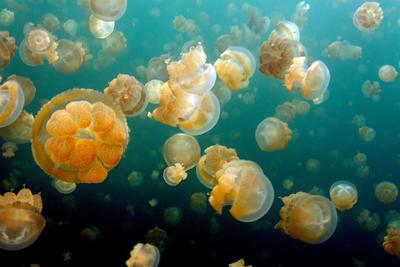
Mastigias jellyfish in Micronesia. Jellyfish are prone to booms and busts in population.
Helmut Corneli
Other researchers attributed any discrepancies in estimates of the rate of species turnover to the time frames of the different studies.
“You might get pushback from people who have observed a net increase in turnover rates using a long time window,” says Jacob O’Sullivan, an ecology modeler at Forest Research, an agency of the British government. “But slowdown does appear to be the correct interpretation [of] their results.”
The new research findings have rekindled a long-running argument among ecologists about how communities of species in natural environments function. At root is the question of whether changes in the composition of natural ecosystems are prevalent, and whether they should be seen as good or bad for the ecosystem.
Most ecologists once believed that healthy ecosystems are naturally stable, with a low turnover of species. Left to themselves, they reach a perfected equilibrium that the influential 19th-century American botanist Frederic Clements termed a “climax ecosystem.” After any disruption, they return to this stable state, a process called succession.
In a world of growing external pressures, increased turnover may indicate the ecosystem is responding and adapting.
This stability was seen as vital, because the functioning of the ecosystem — whether tropical rainforests, temperate grasslands, or polar tundra — depended on tight living relationships between species that had evolved together and were mutually dependent. Predators and prey, and plants and the insects that fed on them and pollinated them, were inseparable. Species turnover disrupted those associations and could lead to ecological breakdown.
Echoing this idea, many ecologists still quote the “rivet-popper hypothesis,” first articulated in the 1980s by biologist Paul Ehrlich of Stanford University. He likened an ecosystem to an aircraft, in which each part, down to the smallest rivet, is vital for the plane to fly safely. Removing a single apparently insignificant species from an ecosystem might be like popping a rivet in the aircraft. It could cause the aircraft to crash — or the ecosystem to collapse. In this framing, species turnover looks like a bad thing.
But detailed long-running studies of unperturbed ecosystems have shown that even the most pristine ecosystems are not so unchanging. In a famous long-term tracking of nature on an island in Lake Superior, Daniel Botkin at the University of California Santa Barbara documented ecosystems constantly changing their composition. “Species in ecosystems are not fixed entities, even without human-induced change,” says Anne Magurran of St Andrews University, the founder of BioTIME. “All ecosystems experience natural turnover.”
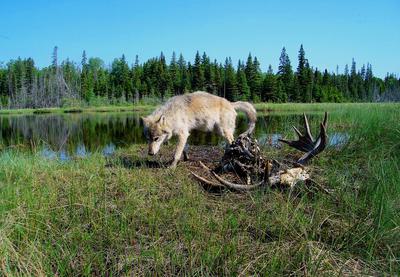
A wolf by the remains of a moose on Isle Royale in Lake Superior, site of a long-running study.
Rolf Peterson / Wolves and Moose of Isle Royale
Ecologists call this natural churn within unstressed ecosystems “intrinsic turnover.” And most now agree that this turnover is a sign not of fragility and imminent breakdown, but, as Terry puts it, “the ongoing back-and-forth of a healthy ecosystem.” It can be driven by internal dynamics such as natural fire regimes that periodically wipe out forests, cycles in predator-prey relationships, or periodic outbreaks of disease. Or it can be essentially random.
Many species, from lemmings to jellyfish, have boom-and-bust cycles with no obvious external cause. Whole ecosystems can also be made up of mosaics of habitat patches that spontaneously shift, such as the regular switches between woodland and grassland seen in some savannah regions of Africa.
Rossberg likens these internal dynamics to a giant, unending game of rock paper scissors. And far from being a sideshow, he says, they appear to be the dominant cause of short-term species turnover. Moreover, in a world of growing external pressures such as a changing climate, increased turnover may indicate that the ecosystem is responding and adapting, with some species going locally extinct or migrating out, while other colonizers move in. Which makes it a positively good thing.
Natural landscapes are increasingly fragmented, so as species disappear, there are fewer opportunities for replacements to migrate from nearby.
If those who adhere to the rivet-popper hypothesis are right, then the new evidence of slowdown might be good news. For it would suggest that most ecosystems are growing more stable, and remain largely uninfluenced by human activities, including climate change. But if, on the other hand, significant species turnover is the healthy norm for ecosystems, a sign of resilience rather than fragility, then any decline in turnover is bad news, especially when turnover is increasingly needed as a survival strategy in a world of widespread human interference in nature.
So, what is causing this unexpected slowdown? Terry says it likely shows that “humans are disrupting the background [intrinsic] turnover of these systems.” Rossberg says the central problem is probably that natural landscapes are increasingly fragmented. So, as some species disappear, there are fewer opportunities for replacement colonists to migrate from nearby. This “slows the pace at which species replace one another,” he says, reducing the ability of the isolated ecosystems to conduct running repairs and threatening their long-term survival.
O’Sullivan agrees. His own research has found that species turnover “increases with both the size of the regional species pool and the connectivity of the landscape. The new study makes the case that a regional decline in [species] richness may explain the local decline in turnover.”
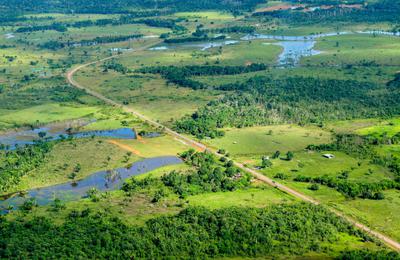
A patchwork of intact forest and grazing lands in the Brazilian Amazon.
Neil Palmer / CIAT
In a sporting analogy popular with some ecologists, there are fewer players “on the bench” to make tactical substitutions if things are not going well on the field. A less fragmented landscape will have a larger species pool “on the bench,” ready to replace those disappearing, and allowing increased species turnover if the situation demands.
Something like this is suggested by a major study published in January on tree-species diversity in the Amazon and Andes. Covering more than 400 forest plots surveyed over four decades, the study found that plots in areas with less fragmented forest had faster turnover rates, as lost species were replaced by new colonists. Their biodiversity held up. But more fragmented forests lost biodiversity, because they were less able to recoup losses with new arrivals from surrounding forests.
The bottom line, most ecologists contacted for this article agree, is that ecosystems in the 21st century need to change faster, with more turnover of species, in order to cope with human impacts, whether local land degradation or global climate change. Staying the same is no longer an option. But if the new study is right that turnover is declining sharply in most places, then they are in even more trouble that we thought.
“Once we accept natural turnover as a force,” says one researcher, “we must accept change as natural and not be fought against.”
So, what does this mean for conservation? One implication is conceptual. The prevailing assumption among conservationists today remains that, as Jacob O’Sullivan of Forest Research puts it, ecological communities “turn over predominantly in response [to] environmental change and direct anthropogenic pressures.” That assumption makes ecosystem change synonymous with ecosystem degradation and suggests that halting species turnover — keeping the ecological rivets in place — should be conservationists’ primary task.
But if, as the new ecology appears to demonstrate, species churn is a routine and necessary feature of healthy ecosystems, then protecting the rivets makes much less sense. “Once we accept natural turnover as a force, we must accept change as natural and not to be fought against, despite our intuition to the contrary,” says James Rosindell at Imperial College London.
Allowing rare and endangered species in some cases to disappear from ecosystems in the expectation that other perhaps more common and adaptable species will take their place, may be a stretch for most conservationists. But Rosindell and other ecologists say we should be more relaxed about the possible local disappearance of species.
“Trying to freeze communities in stasis may well be pushing against the tide,” says Terry. It may simply be putting another wrench in the “engine” of species turnover, blocking the processes of adaptation that ecosystems require in order to survive. It may end up trying to save ecosystems from themselves.