


In today’s escalating climate crisis, more employees are asking how they can make a meaningful environmental difference at work – but where do we start and what can we really do?
In this Transforming Business episode, Martin Parker speaks with Barbara Kump and Babette Julia Brinkmann, authors of ‘The Green Handprint at Work’, about how we can all create change from within our organisations.
They unpack why the idea of a green handprint can be more powerful and motivating than the language of carbon footprints, the different strategies people use to spark environmental change within organisations and how employee activists can sustain hope and resilience while tackling challenges that often feel overwhelming.
Available to listen here, or on your favourite podcast platform:



Barbara Kump is Associate Professor of Business and Sustainability at the University of Twente. Babette Julia Brinkmann is Professor of Organisational and Group Psychology at Cologne University of Applied Sciences.
Scroll down for shownotes and transcript.
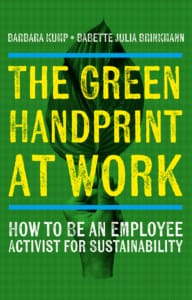 The Green Handprint at Work by Barbara Kump and Babette Julia Brinkmann is available for £19.99 on the Bristol University Press website.
Bristol University Press/Policy Press newsletter subscribers receive a 25% discount – sign up here.
Follow Transforming Society so we can let you know when new articles publish.
The views and opinions expressed on this blog site are solely those of the original blog post authors and other contributors. These views and opinions do not necessarily represent those of the Policy Press and/or any/all contributors to this site.
Image credit: Jacob Thibodeau on Unsplash
SHOWNOTES
Timestamps:
01:05 – How did you get interested in employee activism?
05:25 – What is the difference between a carbon footprint and the idea of a green handprint?
07:08 – Is the phrase ’employee activist’ something of a paradox?
10:11 – Are these changes too small in the face of the larger issue of capitalism?
14:10 – What were some of the most inspirational stories from employee activists?
21:32 – How can people approach decision makers about these changes?
25:26 – What risks can come from being an employee activist?
28:36 – How can employee activists stay resilient?
33:50 – Who do you hope will read this book?
Transcript:
(Please note this transcript is autogenerated and may have minor inaccuracies.)
Martin Parker: Hello. Welcome to the Transforming Business podcast. My name is Martin Parker, professor at the University of Bristol Business School. And today I’m talking to two authors, Babette Brinkmann and Barbara Kump, who’ve written a marvelous book called ‘The Green Handprint at Work: How to Be an Employee Activist for Sustainability’. Barbara is associate professor of business and sustainability at the University of Twente. For over 15 years, she’s researched organisational change towards environmental sustainability, with a focus on how change can be initiated from within.
Babette Julia Brinkmann is professor of organisational group psychology at Cologne University of Applied Sciences. She researches and teaches sustainable and social transitions in organisations and beyond, with a focus on communication and cooperation in divided settings. Babette and Barbara, thank you ever so much for making time to be with me today. Could you start off by saying something about how you got interested in the idea of employee activism?
Perhaps I can throw that one to you first, Barbara.
Barbara Kump: Yeah. Thank you so much for having us. As you just said, I’m a researcher on organisational change processes, and I’ve always been interested in sustainability from, yeah, since my childhood, I would say. And somehow I never really connected that with my work. So I was very interested in sustainability and a sustainable lifestyle in my private life. But in my work life, when doing research on organisations and organisational change, I always focused on how to make companies more, let’s say efficient and better.
But at one point, I realised some seven, eight years ago that that’s actually not what we are supposed to do if we want to have a more sustainable world in general. And I realised I want to do organisational change towards sustainability. And, when talking to people, I felt that people are really many people want that and want to go into that direction, but they feel that they cannot really do much about it because they are often not in leadership positions and so forth. And then, I started looking around and there is a bit or quite some research actually on insider social change agency, let’s say, but nothing really practical. And that’s also how the idea for the book somehow came to be in collaboration with Babette.
MP: And you’d been interested in sustainability for quite a long time too, Babette, then. This was something that you cared about personally?
Babette Julia Brinkmann: Yes. I have a background, maybe I’m more probably coming from the social justice side, I would say. I was an activist myself and pro-European movement and about changing, overcoming national ideas and creating more connected Europe. And for me, the changing moment was really the night of the Brexit, when I woke up in a huge seminar for corporate cooperation and I woke up looking at my phone.
Couldn’t believe what happened overnight. And I went back to this management training I had to give. And I was sitting there and I said, I can’t start as I usually start. We have to start with sharing what happened tonight. And what do you what do we feel and what do we need to continue with where we stopped last night. And following this day I thought, I’m at a university.
I have the freedom to teach and to research on what matters to me. And I decided society in Europe is at risk. And I’m not continuing with how do I make any kind of organisation more successful. I need to shift. And first I shifted partly away from organisations towards social and ecological justice. And then it was really getting to know employee activism and employee activists that brought me back to the field of organisation and opened a door to work on organisations again, getting back to the knowledge and the background I have in organisational development and organisational change and address it to shift in the workplace.
MP: You’ve both told a story of a sort of move from academic interests to a recognition that you have the freedom to explore your own personal politics and ethics, too, there’s a symmetry in that which is really quite inspiring. It’s also nice to see that something good came of Brexit.
BK: Well, maybe. Can I, can I comment on that symmetry? I think that’s also part of what we are trying to do with the book. Right? Both Babette and I, we realised that what we are doing at our workplaces, our handprints, so to say, are really more important than our private life or let’s say, we realised very strongly that our work life really matters.
And that’s the place where we want to make change and can make change, because that’s where our expertise lies. And that’s also what we are trying to convey with the book, to give that sense of hope and agency to other people as well, who are at their workplaces as academics. But in all other areas of society and industry, to really make that change by turning the attention to what they do at their workplaces rather than what they do in their private lives.
MP: That metaphor of the handprint is really important, I think, isn’t it then? So. So, Barbara, can you just explain? You start off by talking about the difference between a carbon footprint and then the idea of a green handprint. So can you just unpack that slightly for readers, obviously you haven’t, listeners who haven’t read the book.
BK: Yeah, I think most people are familiar with this idea of the carbon footprint. And I think that’s remarkable in itself, because I think many by now also know the story, but many also don’t. So the carbon footprint idea has been coined by a fossil fuel company, BP, by their marketing team some decades ago to really shift the burden of responsibility from the producers of fossil fuels to the consumers.
Right to say, yeah, we just produce them, you are the ones who have a carbon footprint, basically. So everybody know now, everybody now knows that flying is not good for their carbon footprint and eating too much red meat and all these kinds of things. So it was a very successful shift of the burden from the producers to consumers.
And it’s a shift that induces a lot of guilt and blame to ourselves in our private lives, and at the same time makes us feel very hopeless and contrast with the idea of the handprint, and in particular, a green handprint. We want to shift the focus from really what to avoid, all these negative things that we leave behind unintentionally, to what we can create with our hands, and where we can co-create more sustainable futures by leaving a greener handprint at the places we spend most of our daytimes anyways.
MP: That’s really nicely expressed, and it focuses very much on the potential agency, the power that people have. You also kind of explore that a bit in your couplet, employee activist I think, don’t you? Because the idea of the employee for many of us is one that involves following orders from the organisation that you’re work in. An activist, by contrast, is presumably somebody who feels free to follow their ethics and politics.
So there’s something of a kind of paradox or tension in that couplet, I guess. Babette, do you want to say something about that?
BJB: Yes. Love to say something about it because this is a tension you feel, that the people we talk to, our interviewees feel it as well. And we even had a longer discussion, Barbara and me, whether to stick with the phrase or not. And we decided to stick with it. I would start with this point and then talk about the tension beside it too.
We decided to stick with the phrase activist because we deeply feel that they deserve it, because activism has this connotation of I am acting out of my own impulse because something needs to happen and those that are in charge are not doing it. This is a setting that is true for all the activism we know from the streets.
And but this is also true for those that we interviewed and that start acting within their organisations. They are looking for the freedom, they’re looking for maybe the green, the gray spaces in an organisation, the back part where it’s not about orders but about finding degrees of freedom that are not controlled and feel it is necessary and if I didn’t do it, no one does it. So and that’s why we feel they deserve it. At the same time, people we interviewed, some of them call themselves proudly activists. But others would say, I’m not an activist. I’m just doing, you know, what needs to be done. Or, I just try to do the best I can, or some would even have the other ones did find titles by themselves, like Eco Warriors, for example, someone called themself, and others call themselves activist.
But for us, it really summarise what it’s about, to do what needs to be done out of your own ethics of your own conviction, out of your own understanding of what justice and ecological justice workplace need to do, and a responsibility for future generation demands from an organisation, and not giving up just because maybe management tells you this is not the right way to go.
MP: That’s really helpful. So there’s again, that sort of, now I’m calling it a paradox or a tension or something like that between being a good employee, a professional and so on. But this idea that that’s in tension with some ethical or political imperatives that you feel. Barbara, one of the sort of elephants in the room here, is obviously the idea that we exist within a capitalist economic system.
Yes. So, you know, some people might say that, you know, the reason, for example, that big companies are emitting so much carbon is because of capitalism. So in that sense, isn’t the sort of thing that you’re proposing quite small when you’re confronting such a big global system?
BK: Yeah. That’s a that’s a big question. That is no laughing matter, just that I got the question. Yeah. We touched upon it in the book and I think it is the elephant in the room that everybody is dealing with. That companies have to make profits and they have to also, in the current system, grow in order to survive in a way.
What we suggest is probably, if you look at the individual actions that are possible is possibly small, but we really follow this idea of chaos theory here. And of chaotic, and complex adaptive systems, that things can change at a point where enough small initiatives have taken place. Right. So it’s really this, this idea that also, for example, Rebecca Solnit in her book ‘Hope in the Dark’, the story or many stories she tells there that many of the developments we saw were not immediately foreseeable, but they were based on many small things that happened at many different places at the same time.
So that’s really our, let’s say, theory of change. That a thing such as modern capitalism cannot be changed by one change at one place in the world. But has to be challenged at many points at once. So our idea is really to prepare the soil to make such a change possible. And, the second thing is that we don’t believe that we have time to wait for the end of capitalism as it exists currently.
So there is also there are different opinions. If capitalism is the only system that would work, or if we have to dismantle it altogether, but whatever our opinion is on that, it is not going to happen tomorrow. And these changes that we need, they have to take place today. And what we want to really encourage is to lay the ground and prepare the soil for changes, so that they can happen when things are ready.
Let’s say. And I always like to say that, for example, something like Greta Thunberg, a phenomenon. It didn’t happen in a vacuum, right? So maybe 15 years ago, a girl sitting in front of a school in Sweden would not have had any impact at all. But the culture, the discourse around it and the initiatives around it, they were preparing the ground that this initiative really could ripple through societies, to have that effect it had back then.
And that’s a bit what we are trying to do with the book, to say we only can make the change by laying the ground at many places at the same time, so that when things shift, yeah, things can shift faster and can be really ripple, let’s say.
MP: Yeah, that’s, that’s nice. I mean that’s a way of starting with where you are and what you can do, but also of recognising, I suppose, the indeterminacy, the unpredictability of those kinds of changes, because it’s quite possible to imagine this is a bit like the butterfly effect, the kind of that some small change might cascade through in quite unpredictable ways.
There’s a beautiful quote from one of your respondents who said something like this. This is my chance to contribute to help. I am part of an 8 billion piece puzzle, and this is the little piece that I can bring to the table. And I really like that, in part because of course, you know, it’s something about a particular individual perspective, but also the recognition that, you know, in any jigsaw puzzle, for example, you’re all linked together, aren’t you?
So let’s talk a little bit about the activists and the kinds of things that they did, that they talked about, how they talked. So, Barbara, could you tell me something about one of the stories or people that you found most inspirational or exciting when you started to play with the idea of an employee activist?
BK: Yeah. One of the most inspiring people I think I talked to very early on was Maren Costa from Amazon, who really realised at one point that she could not continue living like that, working for Amazon and knowing that she would do harm. And she felt she couldn’t defend it to her children anymore, and she really started together with some colleagues to push hard and to really when they realised that they couldn’t do much from the inside to organise walkouts and really, stand their ground and organise.
So that was, of course, one of the most impressive examples. On the other hand, or let’s say on the other extreme of the spectrum, we also talked to people like, Drew Wilkinson, for example, from Microsoft, who were very successful in building a large employee community where they would really collaborate. People could bring in ideas. And Microsoft, in that sense, was very supportive of what they were doing.
So we were talking to all these different activists and, who all had their different strategies that worked in their companies. And we really learned a lot from them on how activism could look like in different companies and which shapes it could take.
MP: In both of those cases. You’re talking about very large companies, aren’t you? So companies with almost ecosystems themselves, within which a particular, let’s say, oppositional movement or collection of people might grow. Babette, can you give some other examples perhaps, maybe not necessarily or anonymise them perhaps, in terms of the sort of stories and ideas that you started to play with in the heart of the book.
BJB: Yes. Welcome to share some stories, because it’s really along the stories that we developed, the book and that we understood what is needed out there to really use the book for action. That’s actually right, because this is the most interesting thing. They are so different. Like there is this very young activist who’s still studying and doing his first internship in an so called ecological focused organisation.
And then you get there and he says, this is not in it. So it’s not what they are doing. They are doing business as usual. I can’t find what I learned at my university. So with an internship, he just starts to fill in some slides in the PowerPoint presentation he’s supposed to do. And then he puts in some ecological knowledge, some more concrete knowledge, data and facts on energy transitions, for example.
That’s a small thing because he just thought, I’m here, I’m surprised and need to start. One other example, on the other end maybe of their career, was a senior consultant at one of the big five strategic consultancies, and she was very concerned not to get an eco warrior image, not to be at all connected to activism, to political convictions, to anything like this, to stay in her role of being a classical strategic consultant as we imagined them.
So she did this. She leaded this project. And at the same time, what she tried to do was keeping an eye on what’s going on in the company and find employees within the company. And, for example, in one huge, logistic company, she spread this idea of finding a think tank on what would a CO2 positive business look like in our business world.
And, she spoke to some employees and supported them to found this think tank. She gave them data and facts and supported them absolutely undercover. And she had shared different examples on how she did this in different companies, in her projects she ran as a strategic consultant, for example. A third one would be a man, who I think had a very interesting strategy.
He’s from a tech company. He was, in coding and tech and at many tech companies, his company as well, started giving open space for employees to do, to dedicate part of their work in social projects. By doing this, he understood that this is where he really wants to dedicate his energy, his creativity to social projects.
And he sat back and said, okay, how can I get there to do what really matters? He read the legal regulations for the works councils in his country, and he read this point sustainability and creating a sustainable future is part of the tasks they should focus on. And by the works counsil his company didn’t do this. So then he said, okay, I’m your candidate.
I will try to get into the works council to get this topic in there. Got elected. Now he has time half of his time to really dedicate to sustainability and he research what is the impact of our company as a consulting company. And the biggest imprint was in finance, in where they invested their money and the pension funds.
They were heavily investing in areas including fossil fuels. So he started to talk about this. He convinced his company to offer different ways of pension funds and to explain this to his employees. And now they can each of them can decide, where do I want my money to be invested from my own pension fund. And that’s not only influencing this company, but it’s also influencing how employees are informed about financial impacts, how they think about financing their own work, their own lives, but also taking important decisions within the company.
So this is like with career path that changed. And he did many projects like this, always including a huge discussion on organisational structures and organisational conditions that impact, yeah, ecological issues.
MP: That’s really useful. And you’ve got a very sort of very distinct set there of stories, haven’t you? Some of which are really about people acting quite covertly, quite secretly, whilst for others they are effectively providing the information for other people to act, hopefully. And in the case of your final one, really acting in the open but trying to kind of tip the scales towards more, environmentally sustainable action. I guess that one of the things that you also came across quite a lot was the idea that this is about kind of changing the ways in which decisions are made, changing the kind of assumptions that people make, and that necessarily involves presumably engaging with senior decision makers as well. So talking to the bosses of some of these big corporations in order to get them to change their assumptions, Barbara would you like to say something about that?
BK: Yeah, I think that, as you just said, it’s really one of the most important points, at whatever level, position you are within your company or organisation. At one point, if you’re not the final decision maker, you will have to convince final decision makers. And that’s also why we dedicated an entire chapter in the book to this question of how to persuade decision makers.
Chapter five and, interestingly, that was also the first chapter that was really clear of what needs to go there. And what do we need to do there. And yeah, I think we cover quite some ground with different scenarios that exist there from people who never heard about sustainability and really need to be informed, and information already really makes a change for them to rethink what they are doing.
Admittedly, those are not so many anymore at the moment, but still, some people told us you wouldn’t believe it. How many people don’t know that eating meat or eating red meat could be a problem, stuff like that. So that was, the first thing we covered to see, okay, how can we inform people? How can we inform them in a way that doesn’t only speak to their minds, but also to their hearts in general about sustainability and the need to make a change?
Yeah. To achieve a more or to reach a more sustainable world, let’s say. Then we cover a lot of, yeah, aspects of persuading managers or decision makers for specific projects. For example, you have an idea that you want to promote within your company. How do you convince people? And there we built on this notion of issue selling also about how to sell issues depending on who is your target, what are their current views of sustainability, what are their values and goals?
And depending on also the effect of the decision you’re suggesting. For example, if you suggest to save energy, that is often something that is sold very easily because it also saves money. If you’re suggesting to change your strategy and make your supply chain more sustainable by including organic products, for example, that often costs money.
So that’s more of a hard sell. And depending on how open your target is, you need different things. And a third important aspect, that we covered, there is this whole idea of ethical blindness or willful blindness of people who believe that they are doing the right thing and believe of themselves to be very morally virtuous, let’s say. People who take good decisions and who do no harm and so forth, who don’t want to look at the effects of the things that they are doing, who don’t, who basically turn a blind eye on, for example, what the customers are doing with their products, with their software, for example, is the software used for drilling oil more efficiently? And then managers might not even want to look at that. And then you need, again, different strategies for how to encourage people to look at these things and also look at those painful realities that their decisions and actions have consequences that are not necessarily in line with their values.
And for all those different situations, we discussed many examples and many strategies on how to talk to your supervisors and talk to decision makers, but also talk to colleagues and other people.
MP: That’s really interesting. And the ways in which many of these employees will be expressing their doubts makes them subject to a certain degree of risk. So the ideal employee, as we were saying earlier, is somebody who is obedient, who doesn’t question the organisation, its leadership, its policies, its business model, and so on. But as soon as you start to express those doubts, then it makes you somewhat subject to a certain degree of suspicion and possibly even risk. Barbara, can you comment on that?
BK: Before I comment on risk, I’d like to say a few words on the idea of the obedient employee, because that is not always what we encountered in these organisations, or let’s say in many of the organisations where we found those employee activists, the organisations had cultures that also really encouraged proactiveness. Right? Bringing ideas, especially big tech companies, for example, are very famous for encouraging employees to bring ideas.
Also, we were talking to people from universities who were trying to make a change there. These are also not necessarily the obedient employees. So there are many organisations that really rely on, let’s call them knowledge workers who bring ideas and are proactive as long as it serves the organisation. And then we arrive at the point that you just mentioned.
So as soon as it starts to challenge the organisation a bit, then of course, you run into a certain risk. And that was very important for us to talk about that also in the book, that employee activism becoming visible, as you called it, comes with some risk and is really important at every point in the process to be aware of that risk and to make a conscious decision on the risk that you are willing and ready to take, given your, I don’t know, career desires, let’s say, but also, of course, your very practical realities of the need to pay your bills or feed your family, stuff like that.
So there is a range of things you can do. As Babette explained before in her examples, that involves more or less risk, right? So if you want to suggest something that is very much in line with the company strategy and could even strengthen its reputation with certain customers, for example, then it’s a rather low risk thing to do, right?
If you say, okay, let’s make this product a bit more sustainable and market it proactively, that will not do much harm. But if you say, let’s step out of the fossil fuel investments we have, or stuff like that as a bank, that might be more risky because much more is at stake and is really important to keep in mind that risk that you are willing and ready to take.
Sometimes you are also maybe surprised how little action already creates a lot of backlash. And then it’s really important to, yeah, to have your strategies ready to be resilient. Also as an employee activist.
MP: Yeah, that’s really nice because I think for many people, of course, they work. They’re an employee because of economic reasons. And they may have some difficulties in thinking about the implications of potentially losing their job or not getting that promotion as a result. So I suppose it’s always a kind of difficult calculation, a very personal calculation for people, isn’t it?
It also requires I guess, that people are very determined, very, as you said, resilient in terms of the focus that they have on particular kinds of change. Babette, could you talk a little bit about how you, in the book, encourage employee activists to stay resilient?
BJB: Happy to go to this question because it’s really an important question. In one interview, one of our interviewees said to me, I need to be alive to make a difference. And it really took her to realise this and this, she was handling a huge activist project within her company and really ran into a depression from this and grave problems.
And then her learning brought this to she said, I need to be alive to make a difference, and you need to address this in your book. That’s what she told us in the interview. And of course, we were going to do this. The problem is the ecological crisis is so big. And then there is this capitalistic system we just talked about behind it and the growth philosophy.
None of us can change this on its own. So what needs to be done is so much bigger than what we can do. And this is the risk to health, to energy, to sustain your movement. It is and this is the simple truth. It’s not going to be enough what you do. What we try in the book, the answer we try to give is, why don’t look at this the other way around.
The change that’s needed is more than you can do, but what is needed from you is exactly the amount of change that you can do. My task can only be to do what I’m able to do at the place where I’m at in this certain moment, and I can only act if I stay healthy and if I stay strong and if I stay connected to my hope.
Maybe there are two different perspectives. The one perspective we address in the book is if I care deeply about the environment and I feel stuck in the wrong workplace, this can also be very harmful psychologically for your energy, for your motivation, and for the central questions in your life. What am I doing every day? So activism might even give a perspective to this connecting to do something that makes sense.
If it is in a scope, you can handle. So this would be the first thing I think taking action can be an answer to the despair you fear. The second is don’t walk alone. Barbara said this earlier about strategies. It is easier to handle if you team up in one way or the other. So we would always recommend, as long as you’re not a whistleblower
I need to say, we would always recommend to start by teaming up and not only on a functional dimension. Who is needed, who is in power and who can reach this decision maker or that decision maker, but also what would be a good team to me to make me feel at home in the team, to decide united what we can do, what we can address.
The third is choose your battles wisely. You cannot go for the entire change of your industry sector, of course, in the first month. Even though it might be necessary regarding the planet, but be realistic and believe in the idea that you do your step relying on many others who are doing differences somewhere else. The change theory we develop at the beginning of the book, which is taken from change theories from social movement in a broader setting, but it very well applies to organisations as well, is taken from mushrooming the idea that there is a mycelium that might not be visible, but that is connected in a way, and you might speak up with a small aspect in a meeting, and you feel I didn’t influence a decision. Again, nothing changed. But maybe you just imagine others heard it and in their hearts it might continue and there might speak up at another corner, or they might start to think differently at something. So things change, even if it’s not visible. So it’s slow space of change needs to be accepted.
Your boundaries are too small, that’s for sure. The problem is bigger than your possibilities. Just accept it. Take the pauses and have like minded colleagues who are there to say stop. Take a break. You need to be alive to make a difference. And I would even say you need to be healthy and happy and very grounded to make a difference.
MP: That’s really great advice, great advice for life as well as great advice for employee activism, I think. It reminds me, of course, of the kind of personal is political idea from feminism in the 1960s and 70s. So this notion that our actions, our individual actions, as well as the actions that we might take together with our friends and colleagues, may have influences that we don’t fully understand, and don’t know.
Barbara, I think that, you know, drawing to a conclusion, one of the lovely things about this book for me is the way that it kind of moves between the big stuff and the small stuff, between kind of talking about capitalism and pro growth and these huge companies and all the rest of it, and then some focus on individuals and their anxieties and their relationships and so on.
That’s a really helpful way of thinking about the possibilities for change, I think. Who do you hope will read this book?
BK: I think I said it before that there is a large amount of people who are at their workplaces, depending on who you ask, 50% of millennials and Gen Z-ers, they don’t want to work for companies that do harm. But at the same time, they also don’t feel that they have a lot of agency. So there is a lot of, let’s call it, potential for change that is not used if people don’t feel they have agency.
So what do we hope to reach are people who want to make a change, who are at their workplaces, but who don’t know how and who feel, maybe helpless or even desperate? So we want the book to be a resource for them. Where we have really collected most of what we know about how to change companies from within together with science, together with some stories from employee activists to give them something, a resource, a companion that helps them to bring their values to work and to leave their own green handprint.
Yeah. So to give them agency instead of despair or hopelessness and to mobilise that large number of people who don’t know what to do and where to start.
MP: In that sense, it’s a wonderfully optimistic book. It’s a book that I read with considerable enthusiasm. As with many social scientists I’m, you know, quite good at seeing the problems. But to see the possibilities that you outlined being laid out so clearly, so attractively, I think was a a really inspirational thing. So thanks very much, Barbara and Babette for writing it.
So my name is Martin Parker, I’m professor of organisation studies at the University of Bristol Business School. And I’ve been talking to Barbara Kump and Babette Julia Brinkmann about their book, ‘The Green Handprint at Work: How to Be an Employee Activist for Sustainability’, published by Bristol University Press. Thanks ever so much, both for spending time with me and I hope the book goes really well.
BK: Thank you for having us. Thank you so much for your interesting questions, Martin.
MP: My pleasure, my pleasure.
BJB: Thank you.
Richard Kemp: Thanks so much for listening to this episode of the Transforming Society podcast. If you’d like to buy a copy of this book, or any other book published by Bristol University Press or Policy Press, we have a 50% discount code valid until the 31st of March. Just go to bristoluniversitypress.co.uk, select your book and then enter POD01 at checkout. That’s POD01 at checkout.