


Experts say a significant portion of the nation’s strategic minerals could come from processing tailings and other waste.
The reclamation process is fairly simple: Sludge collected from mining waste is placed in densely woven bags, and the water percolates out, leaving a high-purity pre-concentrate that is further refined using solvents. Because the system requires no rock grinding or intensive processing, its carbon footprint is about half that of conventional mining and milling operations, according to Paul F. Ziemkiewicz, director of West Virginia University’s Water Research Institute.
The concept of re-mining legacy and abandoned sites is gaining traction around the world as mining companies aim to improve their environmental practices under pressure from investors and from manufacturers who want “sustainable” minerals. Interest is also driven by companies and governments scrambling to procure the 17 minerals known as rare earth elements (REE), in addition to other strategic or critical metals, including copper, which the U.S. Department of the Interior added to its List of Critical Minerals last year.
The race is heated because these commodities have become key geopolitical assets, central to nations seeking dominance in artificial intelligence and computing technologies. (It’s estimated that more than 200 hyperscale data centers are under construction or proposed in the U.S. alone, and each one requires up to 50,000 metric tons of copper.) Last year, President Donald Trump signed an executive order and declared a national energy emergency to speed permitting and short-circuit environmental review of mining and re-mining projects.
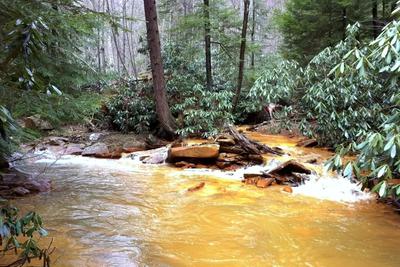
Acid mine drainage from an abandoned coal mine turns Martin Creek in West Virginia orange.
EPA
Experts say a significant portion of the nation’s strategic minerals could come from processing the tailings and other waste left behind in the 19th and 20th centuries, when metals processing was much more primitive and environmental standards were lax or nonexistent.
A recent study by the Colorado School of Mines found that recovering 90 percent of existing byproducts could supply almost the entirety of U.S. critical mineral needs. “Policies and technological advancements can enable byproduct recovery, which is a resource-efficient approach to critical mineral supply that reduces waste, impact, and geopolitical risk,” the authors wrote.
“The material is already pre-ground, and that saves a lot of water and energy,” said Ann Maest, an aqueous geochemist with a Colorado consulting firm and the author of a recent peer-reviewed study of re-mining funded by Earthjustice. “In that sense, I’m a cheerleader for re-mining. If it’s done well and you monitor the water quality and soil quality before and after you mine and you can show you made an improvement, that’s great.”
But for all its promise, re-mining also has the potential to create new problems as companies remove and stir up tailings and other waste that have been dormant for decades, or longer. “Re-mining is mining, and current laws do not go far enough to stop dangerous mining practices,” said Aaron Mintzes, senior policy counsel for Earthworks, an environmental NGO that published a 2024 report on the reprocessing of mining waste. “We need updated mining laws and mining rules. The statute that governs public lands mining is from 1872.”
A Trump administration order will hasten the processing of mining waste by reducing the timeline for environmental review.
As critics have noted, the possible environmental impacts of re-mining have not been well studied and are not well understood. Maest warned that the re-mining’s biggest threat arises when operators handle tailings that have been stored underwater to prevent their exposure to oxygen. Dewatering tailings ponds for metals reclamation can trigger dam collapses, like that which occurred in January 2000 during a re-mining operation in Baia Mare, Romania. The release contaminated the drinking water of more than 2 million people.
The risk of such problems could be exacerbated by the Trump administration’s energy agenda, which would speed up approvals for mining activity. Combined with Trump’s national energy emergency declaration, the president’s executive order — called “Immediate Measures to Increase American Mineral Production” — will hasten the processing of mining waste by reducing the timeline for environmental review under the National Environmental Policy Act from years to weeks by bypassing public comment periods and draft environmental impact statements.
The order reduces the time for consideration of potential impacts to endangered species from 135 to 7 days, and it allows agencies to skip tribal consultation on projects. Many legacy mining sites are on or near Native American reservations or on territorial lands.
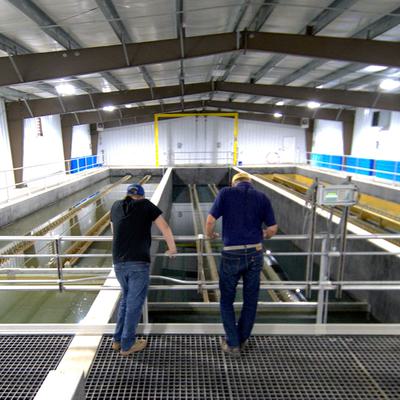
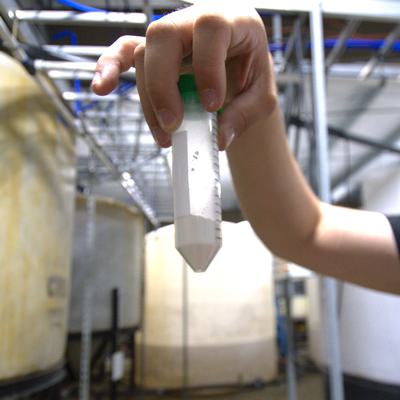
Left: Researchers at a pilot facility in Mount Storm, West Virginia, where rare earth minerals are separated from water draining from an abandoned coal mine. Right: Rare earths extracted by the process.
Marc Levy / AP Photo
Last year the U.S. Department of Energy (DOE) provided $135 million in funding to companies “demonstrating the commercial viability of methods for domestically refining and recovering REEs from mine tailings, deleterious material, and waste streams.”
Trump’s emergency declaration covers all critical minerals, but some see it as a way to usher in other projects as well. “They really want to push the critical minerals because they can get into the whole fast-tracking approach the government is pushing,” said Maest. “But if you look at the schedule, it’s really [about mining] gold.”
Maest offers an example: Idaho’s Stibnite Gold Mine, which was established in 1899 and operated into the late 1990s. Stibnite is situated on the edge of the Frank Church-River of No Return Wilderness, where Perpetua Resources says it will process historic mining waste to produce gold, silver, and antimony — a critical mineral used to make ammunition and batteries. The company plans to clean up millions of tons of waste and safely store the tailings. But according to its plans, it will also mine about 3,200 acres of new ground, an area nearly twice as large as the original mine, and create 15 miles of new roads — on the edge of the wilderness area.
There are an estimated 8,500 tailings facilities worldwide, many of which are leaching toxic substances.
The U.S. is not alone in hastening mineral and metals extraction. The European Union recently loosened environmental standards to speed up the permitting of new mines for rare earths and other strategic metals to free itself from dependence on China. Both Australia and Canada have also sped up the timeline for the permitting of new mines and waste reprocessing.
Beyond the processing of acid mine drainage, other approaches to re-mining are rapidly expanding. In the U.S., the burning of coal at power plants has also produced vast amounts of waste, which is now being eyed for extraction of rare earths. The DOE’s National Energy Technology Laboratory began operation last year of a pilot plant just outside Gillette, Wyoming, to produce REEs from coal fly ash.
Phoenix Tailings, a Boston-based company that produces small amounts of REEs from mining waste and fly ash at its plant in New Hampshire, is building a pilot plant in the Adirondacks to extract REEs from 3 million tons of tailings from an iron mine that operated during the 1940s.
Remediation is a critical aspect of many of these projects. David Cam, the executive chairman of Vancouver-based Envirogold Global, which reprocesses the tailings of shuttered mines for gold, silver, and other critical minerals, claims to “recover 99 percent of the metal and reduce sulfides by better than 96 percent.” The company says it will build its first 500-ton facility in Arizona next year.
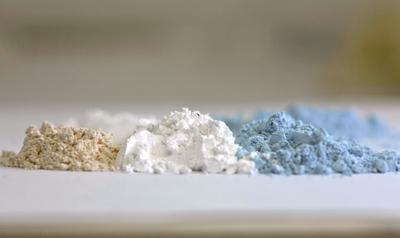
Rare earth elements cerium, yttrium, and neodymium.
dpa picture alliance
Worldwide, there is no shortage of tailings to target. The Global Tailings Review estimates there are 8,500 active and inactive tailings facilities storing 217 billion cubic meters of material, many of which are leaching toxic substances into soil and water.
The environmental problems with re-mining are, in many ways, the same as those with virgin mining, chief among them the lack of strong environmental laws and rigorous enforcement. “There is no country in the world with strong enough laws to prevent significant harm where mining happens,” said Aimee Boulanger, executive director of the Initiative for Responsible Mining Assurance, which inspects mines to assure compliance with voluntary standards. Tesla is one of its clients.
But sustainability in mining, and in re-mining, is a long way off. “We never use the term sustainable,” said Boulanger. “We’re not going to be sustainable until we build in the idea of the circular economy.”
Under the principles of circularity, waste is considered a design flaw, one that can be remedied by designing durable goods for disassembly and the reuse of their constituent parts after they reach their end of life. In this scheme, copper, cobalt, rare earth elements, and other materials with a significant environmental footprint continually cycle, drastically reducing the need for virgin metals and minerals.
Boulanger, who has been working on these issues for more than 20 years, believes this is an opportune time to force change in the industry. “There’s never been as much attention on mining as there is right now,” she said.