


Under an E.U. directive, manufacturers of many household appliances will be required to provide faster and more affordable repairs.
Such efforts will receive a boost this July, when Europe’s “Right to Repair” Directive — which requires member states to support the development of repair initiatives or offer consumers financial incentives to repair their goods — will finally be implemented.
Passed by the European Parliament in April 2024, with a two-year period for companies to adapt their practices, the directive is part of the E.U.’s wider Green Deal strategy to move member states toward a circular economy, which promotes repair, reuse, and recycling to slash both waste and greenhouse gas emissions.
Under the directive, manufacturers of many household appliances will be required to provide faster and more affordable repairs. They must offer spare parts and tools at reasonable prices to anyone who wants to repair a product, throughout its entire average lifespan. If a product needs repairs within two years of its purchase, its warranty will be extended by one year; if a defunct item cannot be repaired, consumers will get the choice of a refurbished second-hand product.
Taken together, said Stefanie Hubig, Germany’s Minister of Justice and Consumer Protection, the author of that country’s draft national law, the new rules will encourage European consumers to opt for repairs more often. “The throwaway society,” she told a German newspaper, “has no future.”

A Repair Café at the German Technology Museum in Berlin.
Courtesy of Kunst-Stoffe
In the past, says René Repasi, the European Parliament’s lead legislator for the directive, manufacturers erected many barriers to repair, like setting high prices for spare parts or using software to block repairs by unauthorized shops. The new rules prohibit such practices.
Now, independent repairers may use secondhand or 3D-printed parts, and producers can’t refuse to service their products just because it was previously repaired by someone else. “This will make repairs more competitive and affordable,” says Repasi.
The repair initiative gained steam after studies by the European Commission found that prematurely discarding products instead of repairing them annually generates 35 million tons of waste and 261 million tons of greenhouse gases through additional resource needs, energy consumption, and waste incineration — equivalent to roughly 8 percent of the E.U.’s total greenhouse gas emissions.
There’s an economic impact as well: Studies showed that the E.U.’s population of 450 million annually spends about $14 billion more on new products than it would have paid for repairs to their old products.
Berlin has allocated $1.25 million to reimburse citizens for using professional repair services or purchasing spare parts.
While “reduce, repair, recycle” has been a popular slogan globally for decades, environmental strategies in Europe have focused less on repair than on recovering resources — like metal, glass, plastic, and paper – from waste streams. Undoubtedly, recycling can reduce the need for newly mined raw materials, but repair prolongs the lifespan of products that already exist.
Taking shoes with run-down heels to a shoemaker, bringing clothes with a broken zipper to a tailor, or asking an electrician to fix a toaster may not seem like a big deal. But collectively the impact can be profound.
“Repairing a smartphone with an average weight of about 140 grams saves 7.3 kilograms of carbon dioxide [versus the emissions toll of making a new one], and repairing a bicycle instead of buying a new one saves 152 kilograms carbon dioxide,” said Jürgen Czernohorszky, Vienna’s city councilor for climate protection, environment, and democracy, who is responsible for a local scheme to incentivize repairs.
And every euro or dollar spent on repairs flows into local economies, he said, instead of sending money to faraway countries. Once repair mandates are implemented, the E.U. predicts, the boost to local businesses will be in the billions.

La Recyclerie, a Repair Café and restaurant in a former train station in Paris.
Thomas Stoiber / imageBROKER via Alamy
But before that can happen, a fundamental problem must be overcome: Repairs are often more costly compared to purchasing new products. According to a study conducted for the European Commission, despite widespread popular support for environmental protection, only about one-third of consumers tend to opt for repair instead of buying something new, with high cost as the leading barrier. The price of spare parts alone can be prohibitive.
“Market research has shown that people tend to buy new products once the repair cost exceeds 20 percent of the original price,” says Tom Hansing of Anstiftung, a nonprofit focused on sustainability.
Then there’s the cost of labor. Electronics and textiles are often produced in low-wage countries in Asia, whereas electricians, tailors, shoemakers, carpenters, watchmakers, and other artisans in Europe need to charge much higher fees to cover their costs.
To help normalize and encourage repair, local and national governments are increasingly intervening to bridge any cost gap. For 2026, the Berlin city government allocated $1.25 million to reimburse citizens up to $237 for using professional repair services or purchasing spare parts for use in Repair Cafés. Since the program was initiated in 2024, more than 14,000 repairs have been supported.
The E.U. mandates that appliances can be opened for repair using commonly available tools without causing damage.
The biggest repair initiative in Europe was rolled out in France, which created a national fund in 2023 into which producers of electronics, textiles, furniture, or household appliances pay a fee based on their products’ quantities, weight, and environmental impacts. Those funds are then used to subsidize customers’ costs at participating repair shops.
Refashion, the organization that administers this fund, has already supported 1.7 million repairs with bonus payments worth over $15 million. The total budget for the period between 2023 and 2028 is more than $183 million, an amount that Refashion says has the potential to increase repairs by 35 percent.
Vienna, too, has experienced huge demand for its repair voucher, which can be downloaded from the city government’s website and redeemed in 60 certified repair shops. “Our scheme was such a great success that the federal government adopted it for repairing and servicing electrical devices,” says Czernohorszky, the city councilor.
Once the new directive is implemented, one of the biggest questions will be whether manufacturers begin redesigning their products to facilitate repairs by, for example, making them easier to disassemble.
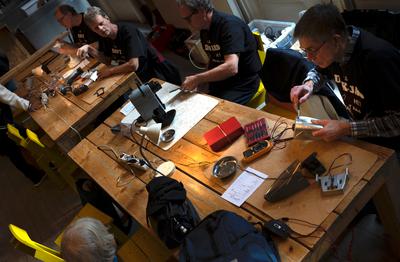
A Repair Café in Amsterdam.
Peter Dejong / AP Photo
“One very frequent problem is that we can’t open the casings of appliances without destroying them,“ says Siero, of the Berlin Repair Café. The E.U. has addressed this problem with its Ecodesign Directive, which mandates that appliances can be opened for repair using commonly available tools without causing damage to the casing or other parts.
Several big electronics companies claim that they are already pursuing the goals of the new E.U. directive. Apple, for example, says it was the first company to launch a “Self Service Repair” program and will now make it even easier for people to repair their devices by allowing used Apple parts — taken from one product and installed in another — to work just as smoothly as new parts, at least in select products.
Samsung says that increasing repairability is one of its major strategic goals, and computer manufacturer Dell emphasizes that it already limits the use of adhesives that might hinder repairs and increasingly uses modular components.
The repair community is demanding more. Campaigners from NGOs remain only partially satisfied with the new regulations. “One weakness is that there are no clear limits on repair costs,” says Hansing, from Anstiftung: The E.U. directive mandates “reasonable” price levels but doesn’t set concrete limits.
Demand for repair is surging in the U.K.: The number of repair groups has increased from 500 to 800 since 2023.
In the U.K., similar demands have been made. “We want the U.K. government to expand the right to repair from household appliances to all consumer products and prioritize repair over recycling,” says Holly Davies, a campaigner for “The Restart Project,” which teaches people how to repair their electronics at its Fixing Factories in London. Demand is surging, says Davies, noting that since 2023 the number of repair groups in the U.K. increased from 500 to 800.
“If we want to get towards a real circular economy,” says Hansing, “we need many fundamental changes — from strong support for voluntary initiatives to a whole new profession focused on repairing.”
Back at the Repair Café, Gürsel Demirca, a trained electrician, spends an hour trying to repair his dead e-bike battery. “If only I had a diagram for the circuit board, fixing this would be so much easier,” he says before eventually giving up. While routinely publishing detailed schematics is not specifically mandated in the E.U. legislation, supporting repair is defined — albeit vaguely — as a fundamental obligation. In the future, Demirca hopes to at the very least get someone at the company to respond to his telephone or email inquiries.
Still, the bike battery is a rare failure. “In 60 to 70 percent of cases,” says Siero, “we can fix what people bring to Repair Café.”
Later that afternoon, the café celebrates another small success when a couple arrives with two broken lamps. Siero discovers that one needs only a new bulb, while the other needs a new part, which he locates in a stack of boxes at the center of the room and swiftly installs.
The couple beams with joy. “We bought this Italian designer lamp just after our wedding 29 years ago,” says the husband, “and now it shines again.”