


Tens of thousands of individuals are affected by disappearance and enforced disappearance every year, but until now the study of this phenomenon has often been disjointed and disconnected due to academic silos.
In this podcast, Richard Kemp speaks with Bahar Baser and Élise Féron, two of the co-editors for the new Journal of Disappearance Studies, about how the journal serves as a space to break these boundaries and give this important field a unified platform.
They discuss the difference between disappearance and enforced disappearance, the ethical implications of speaking for those who cannot speak for themselves and how they hope the journal will evolve over the coming years.
Available to listen here, or on your favourite podcast platform:



Bahar Baser is based at Durham University, UK. Élise Féron is based at Ulster University, UK
Scroll down for shownotes and transcript.
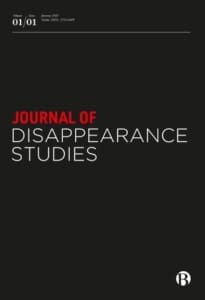 Browse the Journal of Disappearance Studies.
Bristol University Press/Policy Press newsletter subscribers receive a 25% discount – sign up here.
Follow Transforming Society so we can let you know when new articles publish.
The views and opinions expressed on this blog site are solely those of the original blog post authors and other contributors. These views and opinions do not necessarily represent those of the Policy Press and/or any/all contributors to this site.
Image credit: Magda Smolen on Unsplash
SHOWNOTES
Timestamps:
01:28 – What was the inspiration behind starting the Journal of Disappearance Studies?
04:20 – What are the different forms of disappearance?
08:40 – What is it like for the families who are left behind?
14:41 – Why are ‘widows’ particularly impacted?
16:05 – Why are enforced disappearances getting more prevalent?
21:13 – What is transitional justice?
30:54 – Why was it important for the journal to include poetry and filmmaker interviews, alongside academic articles?
34:50 – What ethical issues arise when researching and representing disappearance?
38:54 – How do you hope the journal will evolve in future issues?
Transcript:
(Please note this transcript is autogenerated and may have minor inaccuracies.)
Richard Kemp: You’re listening to the Transforming Society podcast. I’m Richard Kemp, and on this episode I’m joined by Bahar Baser, professor in politics and international relations at Durham University, and Élise Féron, , professor and director of the International Conflict Research Institute at Ulster University. Along with Roddy Brett and Verónica Hinestroza Arenas, Bahar and Élise are co-editors in chief of the newly created Journal of Disappearance Studies, published by Bristol University Press.
Human disappearance is among the least examined issues in global politics, and throughout history it’s been used to brutal effect from the aftermath of missing persons following the dissolution of former Yugoslavia to Pinochet’s military coup of Chile, during which thousands of people were disappeared and hundreds of thousands more forcibly exiled from their homes. Enforced disappearance is a crime against humanity backed up by international law.
And yet, inconceivably, this global problem continues to get worse. In its debut issue, the Journal of Disappearance Studies moves through academic research, interviews with those affected by and working in disappearance, and creative responses from poets to highlight this long understudied issue, advancing research, awareness and accountability. Bahar Baser and Élise Féron, welcome to the Transforming Society podcast.
Thanks so much for coming on and to discuss this new, this brand new journal in such an important subject. Élise, if I could ask you first, please. What was the inspiration behind starting the Journal of Disappearance Studies, and why is it necessary to create a dedicated space for this field now?
Élise Féron: Yeah. Thank you for the opportunity to speak about the journal, first. Yeah. I guess what struck us is what you just said, basically that disappearances are considered a serious human rights violation, but they are not afforded the same attention within academia, but also, interestingly, within the policy and practice field, as other more spectacular forms of violence, I don’t know, terrorism, warfare, genocide, massacre, torture and so on and so forth.
And in parallel, policy responses to disappearances from within the legal or humanitarian sphere or, you know, even within the political sphere, are limited. One of the main reasons for that is that states are party to mechanisms to investigate disappearances they themselves have frequently carried out. So that makes them, you know, church and party. So it’s kind of complicated.
And what also I think drove us is that in addition to historical patterns of disappearances, you know, that we are starting to know better. Like, don’t I know, in Argentina, Colombia, you’ve mentioned a few already. There are new or novel forms of disappearances that have emerged progressively over the past decades. I’m thinking especially about migrant disappearances along the US-Mexico border or in the Mediterranean.
And I think that all of these factors make disappearances an extremely topical and important issue to address. And despite all this, until last year, there was no journal dedicated to the collective dimensions of disappearances. And that is not saying that there hasn’t been any scholarship, you know, on the issue of disappearances. I mean, there has been a very prolific, extremely prolific scholarship across many different fields, especially legal but also psychological, anthropological and so on and so forth.
You know, dealing with disappearances but scattered, you know, all over. And so our idea in creating the journal has been to highlight the area of disappearances and enforced disappearances as a topic and a subfield in its own right, and to foster interdisciplinary research on this. If you want, and perhaps even more importantly, we wanted to create a collective space where the topic can be discussed from these different perspectives.
So academic, policy, but also activist and artistic perspectives. We wanted to give voice to the families of the missing, for instance. And so where empirical cases and stories can be showcased, but also where theories and solutions can be developed.
RK: You say that disappearance can have many meanings and forms. Could you explain the different forms of disappearance?
EF: Yeah, it’s a good question because in a I would say in everyday language we tend to confuse different types of disappearance. And so, basically to explain the categories of disappearance and enforced disappearance belong to a broader category of missing persons. So people can be missing for a variety of reasons which can be voluntary, for instance, when someone wants to leave and wants to disappear for personal reasons.
And they can also be involuntary reasons. For instance, when there is an accident or a crime, you know, something like that. So in order to clarify all of this, the Committee on Enforced Disappearances has come up with various definitions to guide us. So according to the committee, missing persons are, I quote, persons who have disappeared for various reasons.
For example, a natural disaster, armed conflict, trafficking, enforced disappearance, or other reasons. So in the case of missing persons in general, the fact that they are missing might not necessarily be related to political reasons. It might not necessarily be intentional, and it might not necessarily be the result of actions of state or non-state actors. For instance, if you take the case of somebody who disappeared during a tsunami or, you know, a volcano eruption or something like that.
And so within this category of missing persons, the Committee on Enforced Disappearances made another distinction between disappeared persons and enforced disappearances. So let me go back to that. And this is, these two categories are the main focus of the journal. So the first category, disappeared persons are persons who have been the victim of an act committed by human beings.
Right. Whereas enforced disappearance is a disappearance committed by agents of the state or by a person or groups of persons acting with the authorisation, support or acquiescence of the state, end of quote. So for the Journal, our understanding of this enforced disappearance is that it hinges of intentionality. So it’s committed in both in the case of disappearance and enforced disappearance.
It’s committed by human beings, or by states, human beings acting on behalf of a state or a non-state actor. But in the case of enforced disappearance, it’s done intentionally. So let me give you one example. For instance, right now, during the war in Ukraine, there are many, many bodies of soldiers that have disappeared. And we don’t know whether they are alive or not.
They are considered as disappeared and not as enforced disappearances because although they have been killed by other soldiers or bombs or drones or whatever, the act of disappearance was not voluntary. It was not intentional to make them disappear. Whereas in cases like the Pinochet dictatorship that you mentioned, the disappearance of individuals was used as a tool of terror against the opponents of Pinochet.
So it was intentional. So that’s the difference between enforced disappearance and disappearances in general. So in the case, another example of disappearance that is not enforced disappearance is the people disappearing when trying to cross the Mediterranean. You know, they are disappearing because of the inaction of states, right. Or sometimes the action like anti-immigration policies. But it’s not, they do not deliberately disappear them.
So in these cases, people might not be targeted specifically and intentionally for disappearance, but still their fate or their whereabouts become unknown. These are like the broad categories. We could also add other forms of disappearances to that list. For instance, short term disappearances where people disappear for a short time, often because they are detained and their families are left without news, without knowing whether the relative is dead or alive until they are released or officially appear in custody.
But I would say that most of these other categories fall either under the category of disappearances or enforced disappearances, if that makes sense.
RK: Élise you conducted an interview with filmmaker Anne Poiret as part of your, one of your journal articles in which, Anne Poiret she describes speaking to the family of an Algerian victim who was disappeared. The family. They said they accepted his death only after his 100th birthday had passed, even though he disappeared many, many years before that.
Could you tell us the, tell us about the emotional strain experienced by families of the disappeared, the families who were then left behind?
EF: Yeah. This is I mean, as a researcher on these issues, this is probably the most difficult part, you know, of working on disappearances. It’s one of the most devastating aspects and consequences of disappearance. And that’s why, actually, international law treats families as secondary victims of disappearances, not just as witnesses because of this pain that they go through.
So usually in the literature, what you find is the concept of ambiguous loss, which is a very specific kind of suffering. Basically, the concept of ambiguous loss pertains to the fact that unlike death, disappearance offers no certainty. So this means that there is no confirmation of life or death. Nobody to grieve, no grave, no farewell. And it means that for families, hope and despair can coexist at the same time, and that families are left in a sort of limbo.
You know, they are in a liminal state. We say often in literature on the disappearances, and the families feel frozen in time. So, I did interviews, for instance, with widows of disappeared after war between Georgia and Abkhazia that occurred in 92/93. And widows will not, well, they are not widows. They’re half-widows. They are they are not officially widows.
So they cannot move on. You know, it’s difficult for them to accept the loss of their husband or their son or, you know, if it is their son they’re mourning. And so they are completely frozen in time. So, for instance, daughters will not remarry because they are or will not marry because they are waiting for their father, you know, to take them to the church, for instance.
Widows obviously will not remarry because they’re not sure, you know, that their husband is dead, and so on. So the lives of the families become organised around searching. And what is also very important is that this is an intergenerational trauma. So the children inherit silence, they inherit fear. They inherit all those unanswered questions. And that goes, you know, through a number of decades and even generations.
And, for instance, I’ve been working on the disappeared of the Western Front during the First World War. So the war ended more than 100 years ago. And for families, you know, they are still looking for ancestors whom they’ve never met. And they sometimes they come from Australia or Canada, and they go to Flanders or to northern France to try to get details on their missing relatives, on where he was last seen, for instance.
So it’s really important to understand that even decades and generations afterwards, disappearances have a very heavy emotional impact on these, on the families. So because there is no proper closure, you know, it can last for, the grief can last for decades, and it can resurface repeatedly. For instance, whenever there is a rumor, you know, oh, somebody might have seen, you know, somebody, you know, your husband or your son or your brother or something like that.
So it’s a grief that never resolves. And, and families often live in a constant state of alert. You know, they are looking at the news all the time, for instance, in Ukraine right now. They are looking at social media all the time, also using AI to try to identify their missing relative in videos, for instance, of prisoners in Russia and things like that.
And so that can lead to insomnia, panic attacks and multiple physical stress symptoms, you know, higher blood pressure, cardiovascular diseases, heart attacks and so on and so forth. It’s also very common for relatives to experience guilt and self blame. They very often think they could have done something to prevent the disappearance. And they also experience anger, of course, most often directed at the state.
But this anger really has nowhere to go because there is no acknowledged perpetrator. There is no trial and there is no official truth. So it’s very difficult to hold, you know, that anger inside and not having like a, a place or an institution to direct it at. I also want, want to mention fear because often families feel threatened, especially in cases of enforced disappearances.
So they feel threatened, they feel surveilled, and they fear retaliation if they speak out. So this leads them to isolate themselves, which in turn deepens their suffering. And cuts also, cuts them from support, you know, that they might get if they were not isolating themselves. And so, well, I could carry on for a while, but I think that all of these emotions explain why international law recognises family suffering and says that it can amount to torture or cruel, inhuman or degrading treatment.
And so it’s really this suspended state that disappearances entail, you know, that we are in this limbo. There is neither mourning, nor reunion. And this is what makes disappearances uniquely cruel to families.
RK: Did I understand correctly from the journal, widows who are left behind in many cases, that kind of affects their day to day lives, kind of financially, economically as well. Because they’re, they can’t be widows because there’s no official death. Can you speak a bit about that, please?
EF: Yeah, absolutely. I mean, when there is no certificate of death, no recognition that the person has been missing, then it means that widows or even children or, you know, whomever, the relatives don’t have access to a series of economic assets, for instance, let’s say access to property or even compensation from the state, and which also is a complicated topic for them, because if they accept compensation, it also means that they accept that the relative is not coming back.
So, which is also complicated for that reason. So, and in many countries, you know, because we live in a very patriarchal world, women cannot work or, sign documents or even have their own bank accounts, you know, without a man, you know, vouching for them. And so the absence of men and sometimes those absences are multi-generational.
So it’s not just one person in the family who’s missing. It might be the father and then the brother and maybe the son who are missing. It means that for women, it’s very, very difficult to make a living. You know, because of that. But as I said, it also impacts children as well.
RK: The International Convention for the Protection of All Persons from Enforced Disappearance that came into force in 2010. And yet eradication of enforced disappearances is still a major challenge today. If anything I learned from your journal, it’s getting worse. Why is this?
EF: Yeah, it’s staggering. I mean, according to the latest figures released last year by the International Committee of the Red Cross, there has been an increase in 70%. You know, disappearances have increased in 70% over the past five years. And there are, I think, a series of reasons that explain that. The first one is obviously the increased number of extremely violent conflicts and wars.
So the first obvious ones, because they are the top of the international agenda, are Ukraine and Gaza, where we know I mean, in Ukraine, they are hundreds of thousands of soldiers missing whose bodies have not been recovered. And we don’t know, maybe they’re, you know, in detention, maybe not. We know that under the rubble in Gaza, there are probably tens of thousands as well, people who are missing.
So this is, you know, one factor. But we can also quote other cases of conflict, like Syria for instance, Sudan, Eastern Congo, you know, and so on. So in all these places, we have a staggering number of disappeared. And contrary to what you might hear sometimes, the number of violent conflicts has been on the rise for a while now and is actually higher right now than it was since the Second World War.
So the world is witnessing, like a, like a wave of violence that is unprecedented for the past eighty years. The second factor, I think, is the use of disappearance by criminal networks such as drug cartels, especially in countries like Mexico, where hundreds of thousands of people are missing related to drug cartels. And, in that case, it’s also interesting because contrary to what happens during wars, it’s mostly women who are missing in these countries.
Whereas during conflict, it’s mostly men who go missing. The third reason, contributing factor if you want, is migration and anti-immigration policies. I’ve mentioned that before briefly. So especially, well, people want to migrate, but because of anti-migration policies, they have to take very dangerous routes, unsafe transport, they have to use smugglers and so on and so forth.
And this increases the number of missing persons, even when there is no deliberate human rights violation. Deliberate being the keyword here. The fourth reason I can think of is the use of political repression by authoritarian states, which has been on the rise. It’s something that Bahar has been working on as well. Authoritarian states have used disappearance as a tool of repression against their critics, such as journalists, human rights defenders or environmental activists, for instance, in Latin America in particular.
And on top of that, we can add several contributing factors which make the use of disappearance by state and non-state actors easier. So the first one I can think about is the collusion between state actors and non-state power brokers. For instance, states collide with militias, private security or criminal gangs to repress their opposition and to control populations.
And those non-state actors don’t hesitate to use disappearance as a tool of control and terrorism, you know, against civilian populations. Another contributing factor is digital and surveillance technologies. It’s true, and we have a few contributors to the Journal who have worked on that, on how technology can help families track missing relatives. But those technologies also help and enable stronger state surveillance, stronger state control, and that can be misused in repression.
And I would end with another contributing factor, which is impunity, of course. Courts and oversight are weak in many countries. So why would state stop, and non-state actors, stop using disappearances if they are not punished for using it? So the numbers are rising. But it’s also, and it’s very clear. But it’s also worth noting that in parallel there is also more reporting and more awareness around the issue, which means that disappearances that once might have gone unknown are now documented.
And in particular, this documentation has been done by international bodies and NGOs like the UN, Amnesty International, the International Committee of the Red Cross, you know, institutions like that and all those bodies are monitoring disappearances more systematically. So more cases are recorded. But in spite of that, I really want to say again that disappearances are on the rise.
There is no doubt about that. And there is a need for more attention to that matter.
RK: Bahar, can I bring you in here, please?
Bahar Baser: Of course.
RK: Throughout the journal, the term transitional justice comes up a lot in this issue. Can you explain transitional justice and its benefits and its limitations, please?
BB: Thank you so much for this question, and I would like to take this opportunity to thank you for this platform. So transitional justice. Well, it’s a very broad topic, so I’ll try to summarise it as much as I can, doing justice to all the ongoing debates within the field at the moment. And, I will also try to link it to disappearances because that’s why it’s mentioned in almost every article we published so far. So transitional justice refers to the set of processes and mechanisms societies use to address large scale human rights violations, especially after periods of conflict, authoritarian rule or mass violence.
It emerged strongly in the 90s in places like Latin America, South Africa, post-communist Europe, etc. and it is also widely used a la carte, in a way, in the Middle East as well, sometimes successful, sometimes failing. So traditionally it revolves around four main pillars. The first one is of course, truth. So here we can talk about truth commissions, documentation of past atrocities, etc. it also revolves around justice.
So, you know, usually after a transitional justice mechanism put in place, you have trials and prosecutions. So it at least gives you a sense of justice after the conflict. And there’s also issue of reparations. So here we talk about compensations, restitution of rights or other issues or symbolic recognition. And then of course, there’s the issue of guarantees of non recurrence, which is very hard to sustain actually, even after a conflict is concluded.
And here we talk about institutional reform, security sector reform and constitutional change. This is pretty much the traditional understanding. So overall the promise of transitional justice is huge. It aims to acknowledge victims, establish an official record of what happened. You know, hold perpetrators accountable if possible, restore trust in institutions, in governing elites, and help societies move from violent or repressive pasts towards more democratic, peaceful futures.
I’ll come to that point in a minute. But it also creates a shared language for human rights advocacy across the globe. So at least this was the idea. But of course, it has its limitations. And, there is a critical literature surrounding this topic now. So critical scholars argue that, TJ, transitional justice, has become a kind of global toolkit that travels easily and sometimes too easily from one context to another, without really taking into account the nuances in each conflict and each context, etc. so they also criticise, the current understandings of TJ because it’s state centric.
It often assumes that the state is both the main perpetrator and the main problem solver. Even when the state is complicit in most cases and still authoritarian again in most cases. So some scholars find it too legalistic. So there’s a strong focus on courts, formal mechanisms which may overlook the everyday harms which Élise has mentioned in this podcast.
Structural violence or social inequalities that existed long before this transition period. So basically, the legalistic approach sometimes tends to underestimate the root causes. Let’s put it that way. Some find it linear and teleological, so it assumes a move from past violence to post-conflict or democracy, because it comes from the liberal understanding and in many places, violence, repression, authoritarian practices.
They continue even after an armed conflict ends. So under TJ it kind of stops there, because there’s a closure, quote, unquote, yeah? So some scholars also find it selective because political compromises mean that sometimes some crimes, actors or victim groups are recognised while others are silenced. And we see this in many, many peace processes, etc.. So Élise and I have also contributed to this literature before.
So some find it also short term. So TJ mechanisms are often time bound. But if the audience has been following, especially Élise mentioned many times, about the continuing trauma, loss, the social fragmentation, these are all intergenerational. So even the TJ mechanism brought some kind of closure for the conflict. Traumas continue. Root causes keep creating new kind of tensions.
And, when we talk about loss and in the case of disappearances, ambiguous loss, this short term remedy might not help. So basically, critical scholars ask justice for whom, on whose terms and who gets left out of this official story because in the end, transitional justice mechanisms also create their official story about how conflicts end. We see this in Northern Ireland, in South Africa, etc. and I think, when critical scholars ask these questions this is exactly where the missing and the disappeared become central to our discussion. So enforced disappearance especially is one of the most devastating forms of violence. I think we all agree with that, hence we found that journal thanks to, Élise and all these initiatives. It produces a specific condition, right. This permanent uncertainty, especially Élise mentioned that when she talked about how families experienced, it’s this permanent uncertainty.
It is torture in a different way. So families do not know whether their loved ones are alive or dead. This creates what many scholars call this ambiguous loss. Élise also mentioned so a grief without closure. So transitional justice mechanisms can address this kind of issues disappearance, especially, for example, through truth commissions, forensic exhumations and missing persons commissions, etc. we see this in a lot of cases, even where the transitional justice mechanism is not properly taking place, like in Turkey, for example, we still see that these kind of commissions seek justice even outside the premises of an institutional mechanism.
So these are really important because they acknowledge that disappearance occurred. It acknowledges that, you know, these kind of patterns of abuse can be documented in a way. So there can be mechanisms put in place as part of a transitional justice mechanism which can actually facilitate return remains to families. And these mechanisms can challenge the previous official denial and puts in place mechanisms to show that, you know, these atrocities took place, but at the same time, disappearance studies, I think, can expose the limits of the traditional understandings of transitional justice because, as I said, transitional justice, somehow seeks closure.
So a final truth, a completed report. If you think about logistics, you know, a finished transition. Yes. Now this is the roadmap and this conflict ended, a new era begins. But disappearance, by its nature, I think it resists closure in a way. So even when remains are identified. The social, emotional and political consequences continue across generations. So yes, we talked about this example where they finally accepted their loved ones death after the 100th anniversary.
But the perpetrators do not take responsibility all the time. They can’t find every single person who was responsible about what happened. So the trauma lingers and those feelings linger for a long time. Secondly, I would say a disappearance is not only a crime of the past. So in many parts of the world, people are still disappearing through war, migration routes, border regimes.
And as Élise has mentioned, authoritarian practices. So they are not as visible as before. And the idea of post-conflict justice sometimes does not really fit these contexts well, especially when Élise mentioned, these criminal gangs, you know, disappearances related to drug issues, etc., drugs trade. So they do not really fit in to the transitional justice agenda. So disappearance studies kind of transcends the traditional boundaries of transitional justice studies.
And finally, I would say the families of the disappeared often become long term political actors. So when you asked Élise about how families feel, I immediately thought about a recent movie I watched, in Portuguese it’s Ainda Estou Aqui, I’m Still Here. It’s, basically, it’s a nice movie. A Brazilian movie, a movie about Brazil made in 2024, I think.
And I watched it seven months ago, and I’m still thinking about it. It shows you how a family experiences the disappearance of a loved one. And, Marcelo Paiva, I think. And it just shows you that grief takes different forms within the family. And each family member experiences it differently. But it’s always there. Grief is always there.
The feeling of loss is always there. So for, they become long term political actors and their struggle, the families struggle is not only about legal justice, but about memory, recognition, dignity. So they have the right to keep searching. And these forms of activism do not always sit neatly within the formal transitional justice frameworks.
RK: This debut issue of the journal, it brings together academic research, interviews with documentary filmmakers, and poetry as well. What does this interdisciplinary mix allow you to explore that a more traditional academic journal might not?
BB: I am very, very happy with how the journal is designed. I’m very happy that we are bringing in these perspectives, and I’ll try to explain it in a nutshell. So what this interdisciplinary mix allows us to do is to recognise that disappearance is not only a legal or political problem that can be analysed through academic theoretical frameworks. I think we try to show, as Élise has mentioned in the beginning, it’s an emotional, sensory, imaginative experience as well.
So we really want to put together a comprehensive picture. Here are the academic discussions. But at the same time, this is what the families think and this is how artists interpret what’s going on in the field. So a traditional academic journal tends to privilege kind of this, you know, analytical distance, conceptual clarity, theoretical frameworks and how evidence…
They want to show evidence that can be documented, verified, categorised etc.. So this is of course, extremely important. And we respect this kind of academic approaches, we actually comply with them, in most of our work. But disappearance, this topic is precisely about what is not fully knowable. So it’s about absence, uncertainty, waiting, silence.
You know, all the keywords that Élise has used in her part, I think I will just borrow them here. It’s all about loss, absence, feeling of insecurity, fear. So these are things that we cannot measure sometimes scientifically. And they often exceed the language of law or social sciences in general. So I think by bringing together academic research, which we rigorously do, by the way, with filmmaker perspectives and poetry, we are able to explore disappearance on multiple registers at once.
So our first issue, for example, had two poems. And, we have interviews with filmmakers, etc.. So academic research helps us map structures, state violence, border regimes, forensic practices, legal frameworks, so that we can identify patterns of state violence, how disappearances occur, with what motivation, etc.. But these documentary filmmakers work with image, sound and presence so they can show us things that academic articles cannot show us.
Same goes for poetry. They go further into the realm of the unsayable. They use fewer words to talk about broader things. So I really encourage our readers to go and pay specific attention to that section of the journal, because I think that’s where they come even closer to people’s lived experiences and testimonies.
EF: If I may add to that, when we created the journal, we really wanted to, the way we conceptualised it was as a meeting place because we are very indebted to the work of the families of the disappeared, the associations, the lawyers, the artists, you know, that have tried to draw attention to the issue and who have been way more advanced, as I mentioned already, than academics, you know, on this topic.
So I think building a journal on disappearances only around academic contributions would have been dishonest in a way, because most of what we academics work on and what most of what we know is through the work of the families of the disappeared, is through the work of the artists, of the policymakers and so on and so forth. So we really wanted to give them like a central space, you know, in the Journal.
RK: What ethical questions arise when researching and representing disappearance, especially when you’re dealing with real people and communities and unresolved histories?
BB: I think it’s a very important question, and especially working on sensitive topics like this. Thinking about ethics is not a tick box exercise for us. We really need to take it seriously. And I’ll try to explain why. First, there’s the question of speaking about people who are not present. So in our work, we talk about forced disappearances in different contexts, from authoritarian regimes to environmental disasters, as Élise has mentioned.
But when someone is disappeared, they cannot consent, they cannot correct the record or represent themselves. So the knowledge production carries much more weight than in other researches, where we can constantly go and check with the interviewees whether we interpret what they give us in a correct way. So researchers, journalists and artists are always at risk of speaking for the missing, fixing their identity in particular narratives.
I mean, although we try to avoid that as much as possible, but we can still use different frames like victim frame or martyr or political symbol. But maybe, maybe this is not the way they want themselves to be talked about and, or how the families would define them. So there’s an ethical responsibility to avoid turning the disappeared into abstract cases or political or academic instruments for publications, etc..
So this is the first thing. And the having said that, I think most of the people who are contributing to this field are extremely aware of these issues, and they pay extra attention. So, second, there is the issue of working with families who live in ongoing uncertainty. So if you want to work on these cases, and if we think that understanding how families feel is important, of course we kind of incorporate them into our research.
Right? But they are usually, you know, in a state of prolonged, ambiguous grief, as we mentioned. So participating in research or artistic projects can actually reopen their wounds, sometimes intensify hope or revive trauma. And this is valid for many cases if scholars are working on conflict related issues, this always comes up. You know, that’s an ethical dilemma that will always exist.
But on the other hand, we think that, you know, families might want their stories to be heard because visibility helps them to stay on the agenda. So there are many initiatives within the Turkish Kurdish context, for example, that I’m familiar with. And there are many documentaries and activism going on around the disappeared because they wanted to stay in the agenda.
They don’t want to be forgotten, but the ethical challenge is not simply protecting the participants here, but, navigating care and agency and risk all together. And this is hard. So in this case, for example, you can’t just take a consent form and have the family sign it and then, you know, get rid of responsibility. I think people who work on these issues really care about the families.
They form some kind of empathy. But they also understand that informed consent is an ongoing process, not a one off form that they can sign. And there will be emotional impact of interviews and representation on the researcher themselves as well. So we need a really reflexive approach when it comes to working on these sensitive issues. And finally, as Élise has mentioned, there is the factor of fear and political and security risk.
So in case where the disappearances have taken place in an authoritarian context or in a conflict context, and then the fear is still there, it goes for the Mexico context, the criminal networks as well. Right. So the families of the disappeared might, fear from publicly speaking about what happened because they might endanger themselves or activists or the researchers.
So decisions about anonymity, visibility, they need to be approached in an extra cautious manner, in my opinion.
RK: Looking ahead, how do you hope this journal will evolve and what kinds of conversations or contributions are you excited to invite in future issues?
BB: Thank you for this question. I think I’m allowed to say that we are incredibly proud of these first two issues. I think launching a journal is never the work of 1 or 2 people, although they initiate this, but it really takes a whole community to make it last. So I think Élise and Roddy came up with a fantastic idea, and they put so much effort in it, and they should be commended for that.
And then we joined this effort, and now we also owe a great deal to our advisory board members, to our editors, to our publisher, who believed in this vision from the very beginning. So their trust, intellectual generosity and support made it possible to turn this idea into something real, a real platform for us to meet and exchange ideas.
So I would say it truly takes a village to build something like this. And this journal is very much a collective effort. So my first answer would be that I really wish that this collective effort continues. And, the solidarity network we created, in academia, I hope that this will last forever. So looking ahead, there are, of course, lots of aims.
We listed when we found the journal. So I hope, we hope that the journal evolves into a more, into more than a venue for publishing work. As Élise has mentioned, it’s a meeting space for different communities who are all in different ways grappling with these issues, either from an academic or practitioner perspective or from arts or who already have this lived experience of loss.
So one direction I think we’re excited about is broadening how we understand disappearance. And we mentioned that in our introductory piece when we launched the journal. So while enforced disappearance in context of dictatorship and conflict is central and had been central for discussions around disappearance studies, we acknowledge that disappearance also happens through different means now, migration routes, at borders, environmental disasters.
And as Élise has given the example, the criminal networks, drug trafficking, etc. so future issues will bring these conversations together, pushing the boundaries in disappearance studies. Secondly, they are also keen to deepen the journals geographical and epistemic diversity. If you look at our advisory board, you will see that we have representatives from all parts of the globe.
So this is not a journal that’s solely dedicated to Latin America, where these issues are really important, but it’s bringing other examples from different parts of the world and bringing people into conversation, especially from the Global South. So I think it’s really important. And thirdly, we are proud that we have an interdisciplinary and creative approach. So we do not just see this kind of art piece and creative pieces, as an add on to the already existing academic network.
But we acknowledge that, nowadays especially thanks to feminist interventions and others, co-production of research is really important right now, and the outputs of research projects do not just come out as solid, traditional academic articles, but there are other forms. So we are very open to such methodological experiments as well. So we have an open doors policy.
And this is something we are proud of. And finally, I would say looking at the last two issues, especially the first issue, was much more theoretical, it was setting the scene for other articles to come. I think we make it clear that we are interested about fostering conversations beyond the traditional understanding of TJ, which is closure. So we are interested in understanding beyond closure.
We look at disappearances as a long term process, and we want to understand intergenerational memory, how everyday lives are shaped by these kind of uncertainties. So we are not interested in wars and authoritarian regimes and the violence that can be documented. But we are also looking at issues with slow violence and we have a more reflective issue. And, as I said, we are attentive to care and ethics and we will continue to be that way. Thank you.
EF: Just to add to that, I think something that we are keen to do as well is to bring in, because I think in the field there are so many innovations in terms of search techniques, for instance in terms of advocacy, how advocacy could be conducted by families of disappeared and their associations and sometimes our impression is that academic scholarship has been lagging behind all those innovations and we are keen to bring those innovations and those conversations into the academic field, hoping that by bringing these different voices together, then we will really allow for innovation, you know, in terms of how we address disappearances.
But more importantly, in my view, how we prevent disappearances from happening, because I believe that, like Bahar was saying, transitional justice approaches, but also punitive approaches to disappearances, they are not adapted, they do not work, at least right now. And I think we need to think more in terms of prevention and thinking ahead, thinking long term, how we can prevent disappearances from happening so that this horrible, horrible type of violence happens less, if possible does not happen anymore.
So it’s really, I think one of the paths that we are keen on taking as well.
RK: Thanks, Élise and Bahar, thank you so much for coming on the Transforming Society podcast today to discuss your journal. I’m going to let everybody know where they can find your journal in a moment. But first, is there anywhere we can find you online?
EF: You can find me on Bluesky, on LinkedIn and on the Ulster University website. I’m very happy to hear any thoughts the auditors might have. Thank you.
BB: Thank you. You can also find me on LinkedIn and Bluesky and also Durham University website. We are always eager to hear from you.
RK: Excellent. Thank you. Volume one of the Journal of Disappearance Studies, co-edited by Bahar Baser, Élise Féron, Roddy Brett, and Verónica Hinestroza Arenas, is published by Bristol University Press. You can find out more about the journal by going to bristoluniversitypressdigital.com and also transformingsociety.co.uk.