

For Nelson Mandela, the way a society treats its children is a measure of its character, a revelation of its soul.
In the UK, we are contradictory and confused. We rightly feel outrage at landmark cases of child neglect and abuse – Victoria Climbié, Logan Mwangi, Sara Sharif – yet are hostile towards children migrating to the UK, including those who are affected by exploitation and/or abuse, be this en route to or already within the country. All these children, however, are experiencing harms and have a right to protection under international and domestic law.
The rising threat of child trafficking
The trafficking of children in the UK is increasing. The act of recruiting, transporting, transferring, harbouring or receiving children for the purpose of exploitation is a crime, a violation of their rights and a cause of trauma and multiple harms.
The latest official UK statistics show a record high in the number of potential victims of modern slavery referred to the National Referral Mechanism in 2024 – 19,125 people, with almost a third of these children. The most common form of reported exploitation was labour exploitation and the top three nationalities of potential victims were British, Albanian and Vietnamese. Such figures are widely considered to be a significant underestimation.
Barriers to belief and support
While outrage against such exploitation alongside support for recovery might be the expected responses to what these children have encountered, these are not always the reactions that dominate. Child survivors of human trafficking engaged in our research spoke to us about their lived experiences. Some shared stories of not being believed, facing hostility or at times outright discrimination. Others spoke about the need to continuously retell their (often traumatic) accounts to every professional they met, affecting their ability to move forward and feel safe. Our research questions how children’s ‘best interests’ are being served by such barriers and procedures. These procedures, often protracted, meant children were waiting for a solid base on which to build the rest of their lives.
For Zrinka Bralo, such hostility towards refugees and asylum seekers is ‘by design’. There are evidence-based alternatives and possibilities, for example in relation to safe, appropriate and accessible accommodation, but these are not politically expedient. Fortunately, for Bralo, ‘we can do better’. And children thought so too, speaking to us about what they needed in their lives to feel safe and included, and be able to move forward with aspirations for their futures.
Media influence and the ‘adultification’ of children
But messages in the media are powerful, and influence the way children are seen, including by the professionals working with them. While all individuals under the age of 18 are defined as children under the UN Convention on the Rights of the Child, entitled to all associated rights of the child including to protection from harm, there is a tendency by the media and general public to ‘adultify’ children who have forcibly migrated and/or have been exploited. There has also been some dangerous profiling of particular nationalities, based on essentialised views and presented as ‘common sense’. This feeds a criminal justice or immigration framing for these children rather than a child protection one, providing an opening through which mistrust and more hostile treatment can enter.
Finding hope: Guardianship and advocacy
Our research, however, also revealed accounts of positive outcomes for children affected by human trafficking. In particular, children and young people provided with independent guardianship or other advocacy support in the UK expressed a sense of hope. A focus on post-exploitation positive outcomes – beyond mere survival – emerged from children’s discussions with us about their search for safety, their strengths, capabilities and finding ways to restore their everyday lives.
Child survivors’ negative experiences led us to consider how these children might be viewed differently. Where predominantly adult-focused immigration and criminal justice lenses had been applied, we suggest there is a relationship between exploitation, child safeguarding and protection which call for exploitation to be more firmly recognised as a fifth form of child maltreatment, alongside physical, sexual, emotional abuse and neglect. The adverse outcomes resulting from exploitation vary, but as yet we do not view them in the same framing as other forms of abuse or child maltreatment. Risks outside the family home are now part of child protection agendas in the UK but we lack understanding of these in the context of exploitation in its multiple forms.
The importance of language and definitions
Definitions and words matter. Our findings highlight that the nature and descriptions of differing forms of exploitation shift and evolve, with terminology connected with human trafficking, exploitation or ‘modern slavery’ needing to better reflect the realities of children’s lives. ‘More Than Words’, a new report recently released by ECPAT UK (Every Child Protected Against Trafficking) and co-commissioned by the UK Independent Anti-Slavery Commissioner and the Modern Slavery and Human Rights Policy and Evidence Centre (PEC) at the University of Oxford agrees, and reveals significant issues with the UK’s approach to child trafficking and exploitation terminology, which leaves many children formally unrecognised. Definitions help shape how problems such as child exploitation are understood, the kinds of responses that are put in place as well as who is considered to be in need of protection.
There is considerable need for better support during the transition from child to adult services. Children engaged in our research and approaching the age of 18 shared their anxieties about having to leave independent guardianship and other child-focused services and practitioners. Professionals spoke about a ‘cliff edge’ at 18 where children could become lost in transition within the system and more at risk.
Refocusing on rights, protection and futures
If a measure of society is the treatment of its children, the lived experiences of young survivors of trafficking and exploitation as captured in our book must give us pause. We are at a critical point in the UK where there is an urgent imperative to refocus more positively on the rights, outcomes, aspirations and futures of children who have been affected by exploitation, revealing their ‘whole selves’. We also need to shift our frameworks, media and public opinion away from hostile lenses and language towards protection from exploitation and provision of early intervention to minimise harm when exploitation is identified. Seeing exploitation as a fifth form of child abuse can help us move away from current hostility and pejorative language for children and young people finding their way out of harm.
Anna Skeels is Research Fellow at the Social Science Research Park (SPARK), Cardiff University.
Patricia Hynes is Professor of Social Justice at Sheffield Hallam University.
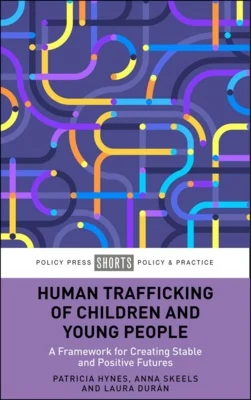 Human Trafficking of Children and Young People by Patricia Hynes, Anna Skeels and Laura Durán is available to read open access on Bristol University Press Digital here.
Bristol University Press/Policy Press newsletter subscribers receive a 25% discount – sign up here.
Follow Transforming Society so we can let you know when new articles publish.
The views and opinions expressed on this blog site are solely those of the original blog post authors and other contributors. These views and opinions do not necessarily represent those of the Policy Press and/or any/all contributors to this site.
Image credit: Farhan Abas via Unsplash