


January 2026 began in an extraordinary fashion in Venezuela. Without a single mass protest, its president was ‘ousted’. The subterfuge behind the US-led capture of President Nicolas Maduro was criminal. Maduro was allegedly linked to the Tren de Aragua cartel.
Two years earlier, though, protests were ubiquitous, with mobilisations held throughout the country to denounce an electoral fraud. Re-elected Nicolas Maduro was not their president, they chanted. And for mobilising, thousands were arrested, many were ‘disappeared’ and 24 were killed.
While it is highly improbable that Maduro himself is part of a cartel, these recent developments underscore the complex reality faced by activists in Latin America – a reality defined not only by state repression but also by the substantial influence and coercive power of non-state actors, including established cartels.
For activists across Latin America, violence is not an exceptional risk attached to protest, but a constant condition shaping when, how and whether collective action is possible. Protesting in Venezuela – and in other countries in Latin America – remains arduous, as the examples of Nicaragua in 2018, Colombia in 2021 and Peru in 2023 show. Given this landscape, social movement studies often lack an account of the permanent character of violence that moves beyond a narrow focus on increasingly frequent lethal state repression.
The paramilitarisation of protest policing in Latin America
It is now common sense to state that Latin America is a complicated region for activists. Recent Global Witness reports indicate that Colombia, Mexico, Brazil and Honduras have consecutively topped the list for the murder of activists.
What reports fail to delve into are the nuances of such data. One such subtlety is that while the state still plays an important role in repressing people, it is extra-legal actors who constitute the hidden undercurrent in social movement analysis.
I aggregate them in the paramilitaries category, that is, autonomous groups of armed men, often linked to the state, in order to distance themselves from extreme manifestations of violence.
Examples include the Juventud Sandinista in Nicaragua, which acts as an informal militia of the current president, Daniel Ortega, and paramilitaries acting in tandem with the police to repress people who took to the streets in Colombia’s 2021 Wave of Protest.
Among different case studies in my research for Latin American Activism and Routine Violence in the 21st Century, I examine the case of 26-year-old Esteban Mosquera in Cauca. In 2018, he had been a victim of police violence when tear gas from Escuadrón Móvil Antidisturbios (ESMAD) cost him his left eye. In 2022, he was assassinated by the paramilitary group Los Ovejos.
Mosquera’s story is not the only one in Latin America.
Beyond exceptional events: Violence as a routine condition of activism
Documenting such tragic, exceptional events also prompts an enquiry into the undocumented violence faced by activists in different social movements. What I argue is that, while such reports of extraordinary violence dominate the news, it is the many instances of routine violence that impede activists from organising.
For social movements, violence is routine, and not extraordinary.
I investigate how the routine elements of this violence are embedded in everyday practices. After all, violence is so prevalent that protesting is not always possible; it is ubiquitous, but is often only reported when it reaches an extraordinary scale.
While one must consider a myriad of threats – including extortion, kidnapping and physical attacks – in many rural and, to a lesser extent, urban Latin American areas, the mere possibility of suffering such forms of violence creates a permanent state of insecurity for everyone, including activists.
This environment is defined by a profusion of armed actors and practices that cannot easily be isolated, occurring both because of the ambiguity of the roles assumed by these subjects and because their violence is constantly looming.
Historical legacies of violence and contemporary collective action
Conversely, a historical convergence of riots, looting, state, paramilitary and guerrilla massacres continues to shape collective action.
In the 21st century, activism often draws on transnational ties; however, the benefits of these networks are deeply context-dependent, varying according to a country’s economic situation, Indigenous background and specific repertoires of contention.
Feminist urban marches in Montevideo, Uruguay, calling attention to feminicides, differ significantly from 2025’s Indigenous paros nacionales in Quito, Ecuador. But they converge as collective actions in a region marked by a recent past of struggle against dictatorships and financial constraints.
In many ways, the violence activists face can have a chilling effect on social mobilisation. To take part in contentious activities is dangerous, whether for exceptional moments of violence or the colonial and routine violence of most contexts. Also, repression in the region works differently from the Global North, as activists usually endure more frequent and severe forms of persecution, criminalisation and assassination.
No easy alternatives: Organising amid permanent violence
While this book begins with ‘spectacular’ protest waves and eruptive violence, these events do not fully encapsulate the contemporary situation. Even when violence is missing from the analysis, it has nevertheless been frequent in many forms across most countries in this century.
One must counterpoint expectations of redemocratisation that, in Latin America, presumed the pacification of politics, a byproduct of the end of military dictatorships and armed struggles.
While arguing that the fate of Latin American social movements is intrinsically linked to state-organised crime or the violence of paramilitary forces, I do not claim we are dealing with violence-prone societies or violent democracies. Rather, the targeting of dissent by state and non-state actors helps create a perpetual climate of violence, and mobilisation needs creative, albeit reactive, alternatives.
In Venezuela, 2024’s death toll was high, as was the toll during Peru’s 2023 mobilisations. What we fail to understand is what lies beneath social organisation and the lack of opportunities therein.
The fundamental problem of violence within liberal democracies is stated in this research, as criminal organisations, such as cartels, pandillas and other collectives, together with hitmen and mercenaries hired by transnational mining and extractives companies, should be seen as emergent repressive agents in social mobilisation in Latin America.
Simone da Silva Ribeiro Gomes is an Associate Professor at Universidade Federal de Pelotas. She holds a PhD in Sociology from IESP-UERJ and an MSc in Sociology from Université Paris 7.
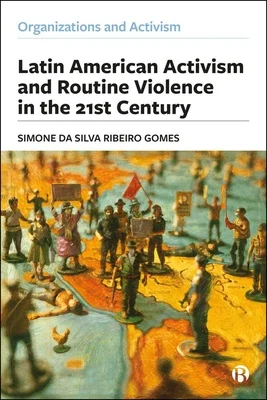 Latin American Activism and Routine Violence in the 21st Century by Simone da Silva Ribeiro Gomes is available for £80.00 on the Bristol University Press website here and Bristol University Press Digital here.
Bristol University Press/Policy Press newsletter subscribers receive a 25% discount – sign up here.
Follow Transforming Society so we can let you know when new articles publish.
The views and opinions expressed on this blog site are solely those of the original blog post authors and other contributors. These views and opinions do not necessarily represent those of the Policy Press and/or any/all contributors to this site.
Image credit: Denise Bossarte via Unsplash