


You might appreciate snowpack as something to sled, ski, or snowboard on. But beyond the slopes, vast masses of snow melt as winter turns to spring, feeding rivers and streams, which go on to hydrate towns and cities and crops. We’re talking incredible amounts of water: California, for instance, gets 30 percent of its supply from the snowpack in its Sierra Nevada mountains.
But across the American west, that bounty is in trouble as the climate quickly changes: The region is currently in the grip of a severe snow drought, as more precipitation falls as rain. At the same time, higher temperatures are desiccating the landscape, fueling massive wildfires once all that snow melts away. Not helping matters is a long history of fire suppression — quickly stamping out blazes has allowed dry vegetation to accumulate, adding yet more fuel to the flames.
Scientists seem to have found a way to help alleviate the West’s fire and ice problems simultaneously, at least in Washington state. Working in the forests of the Cascade Mountains, researchers divided plots on the south and north slopes of a ridge and thinned their vegetation to varying degrees: Trees like ponderosa pine and Douglas fir were left different distances apart, for instance, determining how dense the growth could be. (The image above shows what the landscape looked like to start, and the two below show different intensities of thinning.) After the pack formed, they measured the thickness and density of the snow in each plot. That way, they could show the difference between an area where trees were, say, 15 feet apart versus 30 feet, and compare those plots to ones that hadn’t been thinned at all.
Western states will no doubt be interested in what these researchers found: up to 30 percent more snowpack on the thinned plots compared to the areas left unkempt. Scaled up, that would mean an additional 4 million gallons of water per 100 acres of forest. Furthermore, the researchers identified a sweet spot, where foresters would get similar benefits with a tree spacing anywhere between 13 and 52 feet. “It gives foresters a lot more flexibility in how they can manage their trees, depending on what species are there,” said Emily Howe, an aquatic ecologist at the Nature Conservancy, who coauthored a new paper describing the research. (The Conservancy owns the property where the study occurred.)
This density mimics what happened naturally on these landscapes before humans showed up, when vegetation would grow and die back, accumulating as tinder. All it took was one lightning strike to get a conflagration going. “We’re not talking like big, catastrophic wildfires that burn everything in their path, because it happened so frequently,” said Susan Dickerson-Lange, director of the Climate Impacts Group at the University of Washington and coauthor of the paper. “These fires naturally clear out some of the underbrush. They burn some of the trees, but not all of the trees, leaving this very sort of patchy dynamic.”
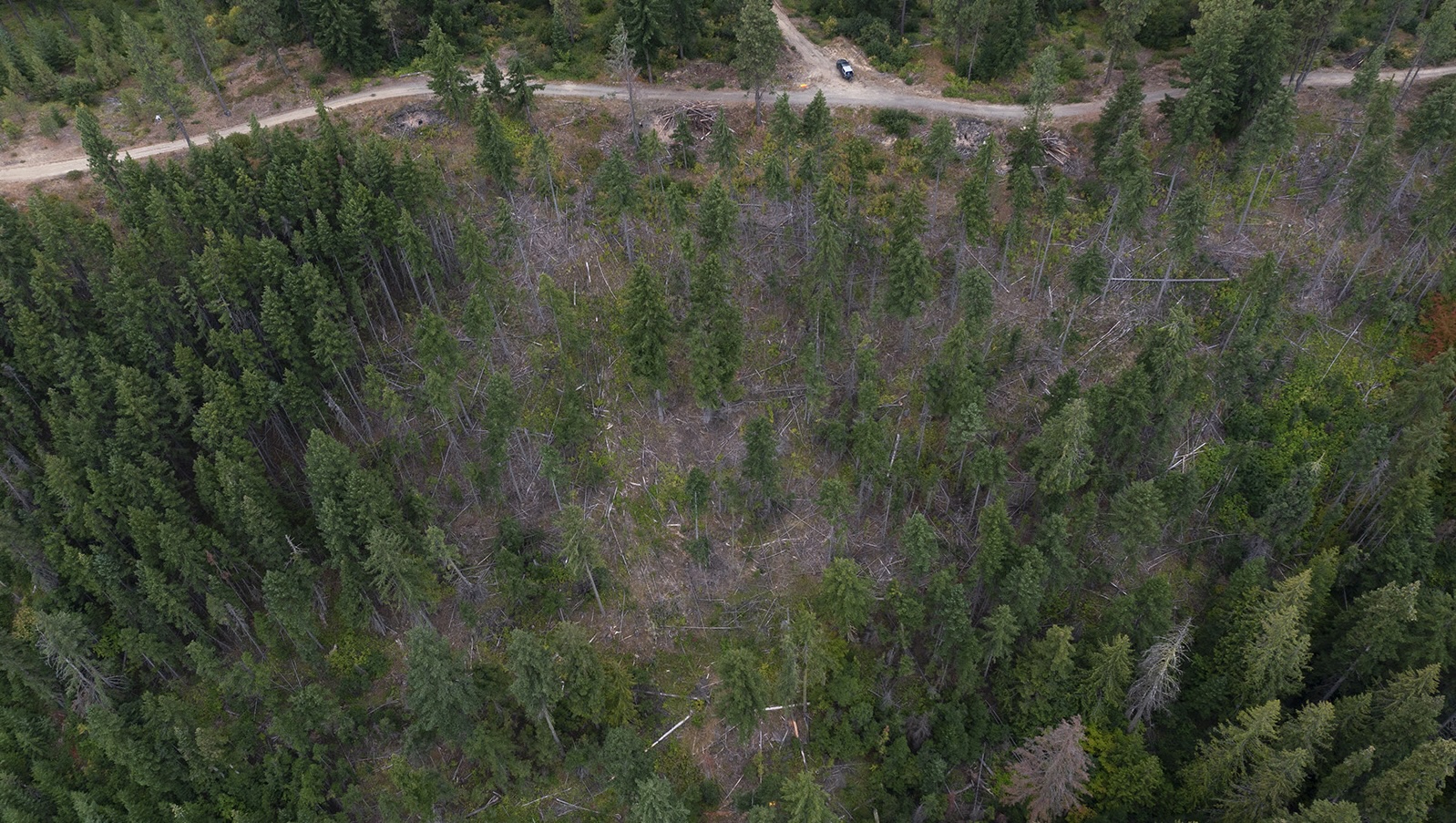
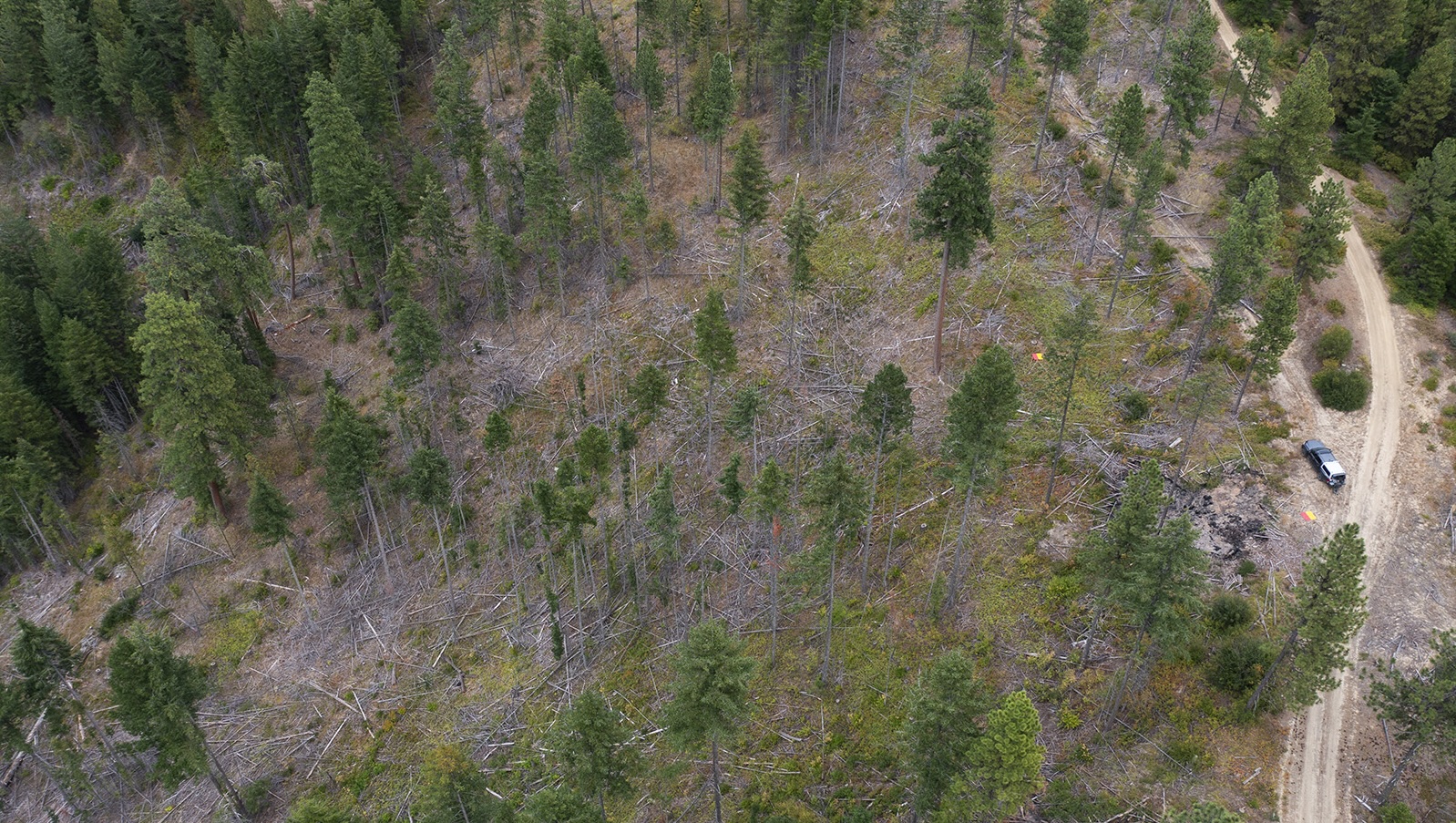
Scientists compared snowpack in forest areas that underwent moderate thinning (left) compared to heavy thinning (right), which increasingly opened up the landscape. John Marshall
That gentler ecological reset would do two things: Prevent the giant, landscape-obliterating blazes we’re coping with today, and boost biodiversity by making space for new vegetation, which would in turn attract grazing animals like deer. Indigenous peoples knew this well, and have a long history of using controlled burns to mimic the natural wildfire process. Indeed, they’ve been instrumental in getting fire agencies to do more of this kind of management lately.
In Washington, these researchers did their work with lidar, in which an airplane or drone fires lasers at the ground and measures what bounces back. Because scientists know the speed of light, a laser pulse traveling just a fraction of an inch farther comes back as a reading of a different elevation. The researchers first created a map of the area without snow, then another with the pack in place — combining the two provided an extremely detailed look at the depth of all that white stuff at any one spot. Lidar also mapped the tops of the trees, providing a snapshot of the vegetation. “It’s pretty neat — it’s almost like as if you drape a sheet over all of the trees,” Dickerson-Lange said. “So we could both look at how the canopy changed from forest thinning, as well as how the snow changed from forest thinning.” (Figuring out the density of the snow required a bit more work: The researchers had to actually visit the site and take samples.)
Previous research has found that depending on where you are on the landscape, a forest can either accelerate or delay the melting of its snow. Shade, for instance, will preserve it, but the trees also absorb and radiate solar energy, which melts it in unshaded spots. “That snow pack on the ground, even if it’s discontinuous in patches in between trees and the open gaps, it’s serving as a nice time-release storage mechanism of water,” said Daniel Swain, a climate scientist who studies weather and wildfires at University of California Agriculture and Natural Resources, but wasn’t involved in the research.
Overall, the new research finds that thinning this particular forest led to a net gain of snowpack. That’s because if the trees were crammed together, their crowns would intercept more snow, some of which would evaporate away without touching the ground. With more gaps, more snow can reach the forest floor and accumulate through the winter.
Still, scientists will have to do more research to figure out if the same goes for other regions — not only does every state have its own unique climates, but every forest is unique, too. And even different parts of the same forest will interact with snowpack in different ways. “This is why this is a very complex topic, and it’s very difficult to take the results from one site and try to generalize and apply that over a large spatial scale,” said Safeeq Khan, a hydrologist at the University of California, Merced, who wasn’t involved in the research but does similar experiments.
Interestingly, the researchers found a significant difference between the plots on the north and south slopes: While the former saw that boost of 30 percent, the latter saw about half that. Dickerson-Lange said that forest managers have tended to do more thinning on south-facing slopes, because they have a tendency to be drier and more prone to burn. “But these data suggest that there’s potential for greater water benefit to do heavier, more intense thinning on the north-facing slopes,” Dickerson-Lange added.
The urgency here is real, as climate change dramatically alters how much snow falls on the American west (the Cascades could lose half of its annual snowpack in the next 70 years), how long it lasts, and how much of the water eventually makes it to human populations. For researchers, then, snowpack is a rapidly moving target. “Eventually we are going to move to a point in a couple of decades where these snow-dominated ecosystems become rain-dominated, and now those dynamics are going to be different,” Swain said. “This winter is a great example of a year where, unfortunately, this effect was largely irrelevant, because really, there’s just no snow pack at that level at all.”